
Kingdom
Pseudomonadati
Phylum
Pseudomonadota
Class
Gammaproteobacteria
Order
Lysobacterales
Family
Lysobacteraceae
Genus
Xanthomonas
Description
Taxonomy
| Kingdom | Pseudomonadati |
|---|---|
| Phylum | Pseudomonadota |
| Class | Gammaproteobacteria |
| Order | Lysobacterales |
| Family | Lysobacteraceae |
| Genus | Xanthomonas |
| Species | Xanthomonas translucens |
| Strain | pv. translucens DSM 18974 |
Profile
| Physiology | |
|---|---|
| Gram staining properties | Not Available |
| Shape | Rod |
| Mobility | Not Available |
| Flagellar presence | Yes |
| Number of membranes | Not Available |
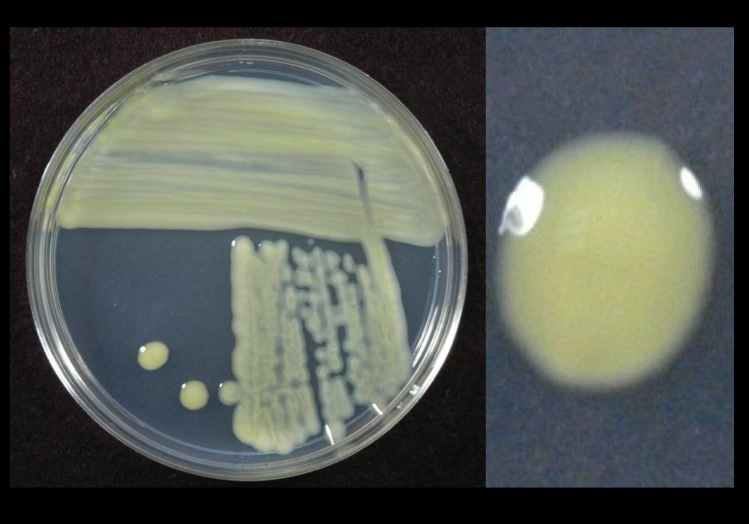
Image source: Wikipedia/Wikimedia
| Ecology, Host, and Life Cycle | |
|---|---|
| Oxygen requirements | Not Available |
| Optimal temperature | Not Available |
| Temperature range | Not Available |
| Habitat | Not Available |
| Biotic relationship | Not Available |
| Host(s) | Not Available |
| Cell arrangement | Not Available |
| Sporulation | Not Available |
| Energy source | Not Available |
| Pathogenicity | Not Available |
Gene Summary
Adenine Count
761023 bp
Thymine Count
761004 bp
Guanine Count
1595345 bp
Cytosine Count
1597985 bp
Genome Length
4715357 bp
Protein-coding Genes
4033 genes
Non-Coding Genes
65 genes
# of Chromosomes/Plasmids
1
Genes
| Name | Locus Tag | UniProt ID | Strand Orientation | Gene Start/End | Protein Molecular Weight |
|---|---|---|---|---|---|
| response regulator | BFP94_RS16280 | Not Available | Negative | 3905210 - 3905938 | 26629.2 |
| sensor histidine kinase kdpd | BFP94_RS16285 | Not Available | Negative | 3905928 - 3908618 | 97807.6 |
| potassium-transporting atpase subunit kdpc | BFP94_RS16290 | Not Available | Negative | 3908691 - 3909326 | 21881.3 |
| potassium-transporting atpase subunit kdpb | BFP94_RS16295 | Not Available | Negative | 3909368 - 3911428 | 70647.8 |
| potassium-transporting atpase subunit kdpa | BFP94_RS16300 | Not Available | Negative | 3911439 - 3913160 | 60520.7 |
| potassium-transporting atpase subunit f | BFP94_RS16305 | Not Available | Negative | 3913177 - 3913269 | 3322.19 |
| outer membrane beta-barrel protein | BFP94_RS16310 | Not Available | Negative | 3913566 - 3915071 | 55637.8 |
| coce/nond family hydrolase | BFP94_RS16320 | Not Available | Negative | 3915704 - 3917281 | 54408.5 |
| thiamine-phosphate kinase | BFP94_RS16325 | Not Available | Negative | 3917507 - 3918484 | 33574.8 |
| transcription antitermination factor nusb | BFP94_RS16330 | Not Available | Negative | 3918616 - 3919083 | 17404.7 |
Pathways
0 pathways
No pathways found
No metabolic pathways have been associated with this bacterium yet.
Health Effects
No health effects information available for this bacterium.