
Kingdom
Pseudomonadati
Phylum
Pseudomonadota
Class
Gammaproteobacteria
Order
Lysobacterales
Family
Lysobacteraceae
Genus
Xanthomonas
Description
Taxonomy
| Kingdom | Pseudomonadati |
|---|---|
| Phylum | Pseudomonadota |
| Class | Gammaproteobacteria |
| Order | Lysobacterales |
| Family | Lysobacteraceae |
| Genus | Xanthomonas |
| Species | Xanthomonas translucens |
| Strain | pv. translucens DSM 18974 |
Profile
| Physiology | |
|---|---|
| Gram staining properties | Not Available |
| Shape | Rod |
| Mobility | Not Available |
| Flagellar presence | Yes |
| Number of membranes | Not Available |
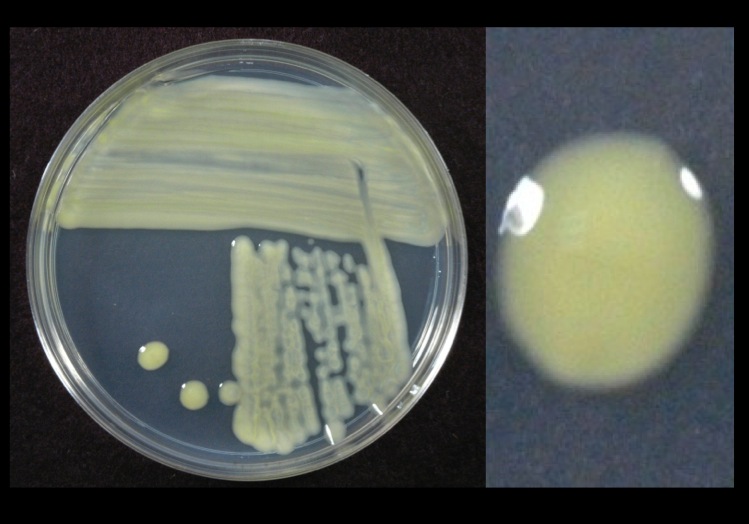
Image source: Wikipedia/Wikimedia
| Ecology, Host, and Life Cycle | |
|---|---|
| Oxygen requirements | Not Available |
| Optimal temperature | Not Available |
| Temperature range | Not Available |
| Habitat | Not Available |
| Biotic relationship | Not Available |
| Host(s) | Not Available |
| Cell arrangement | Not Available |
| Sporulation | Not Available |
| Energy source | Not Available |
| Pathogenicity | Not Available |
Gene Summary
Adenine Count
761023 bp
Thymine Count
761004 bp
Guanine Count
1595345 bp
Cytosine Count
1597985 bp
Genome Length
4715357 bp
Protein-coding Genes
4033 genes
Non-Coding Genes
65 genes
# of Chromosomes/Plasmids
1
Genes
| Name | Locus Tag | UniProt ID | Strand Orientation | Gene Start/End | Protein Molecular Weight |
|---|---|---|---|---|---|
| wg repeat-containing protein | BFP94_RS12635 | Not Available | Positive | 3063997 - 3064536 | 19445.9 |
| trna lysidine(34) synthetase tils | BFP94_RS12640 | Not Available | Positive | 3065013 - 3066359 | 48254.1 |
| exodeoxyribonuclease vii small subunit | BFP94_RS12645 | Not Available | Positive | 3066391 - 3066654 | 9683.41 |
| polyprenyl synthetase family protein | BFP94_RS12650 | Not Available | Positive | 3066644 - 3067525 | 30140.1 |
| winged helix-turn-helix domain-containing protein | BFP94_RS12655 | Not Available | Positive | 3068344 - 3069024 | 25533.7 |
| cytochrome-c peroxidase | BFP94_RS12660 | Not Available | Positive | 3069096 - 3069965 | 31436.2 |
| two-component system vira-like sensor kinase | BFP94_RS12665 | Not Available | Positive | 3069962 - 3072379 | 87822.7 |
| lysr family transcriptional regulator | BFP94_RS12670 | Not Available | Positive | 3072490 - 3073467 | 34591.7 |
| type vi secretion system protein tssa | BFP94_RS12675 | Not Available | Positive | 3073464 - 3074492 | 37461.7 |
| hypothetical protein | BFP94_RS12680 | Not Available | Negative | 3074506 - 3074799 | 10906.4 |
Pathways
0 pathways
No pathways found
No metabolic pathways have been associated with this bacterium yet.
Health Effects
No health effects information available for this bacterium.