Kingdom
Pseudomonadati
Phylum
Pseudomonadota
Class
Gammaproteobacteria
Order
Enterobacterales
Family
Enterobacteriaceae
Genus
Salmonella
Description
Taxonomy
| Kingdom | Pseudomonadati |
|---|---|
| Phylum | Pseudomonadota |
| Class | Gammaproteobacteria |
| Order | Enterobacterales |
| Family | Enterobacteriaceae |
| Genus | Salmonella |
| Species | Salmonella enterica |
| Strain | subsp. enterica serovar India SA20085604 |
Profile
| Physiology | |
|---|---|
| Gram staining properties | Negative |
| Shape | Spirilla |
| Mobility | No |
| Flagellar presence | Yes |
| Number of membranes | 2 |

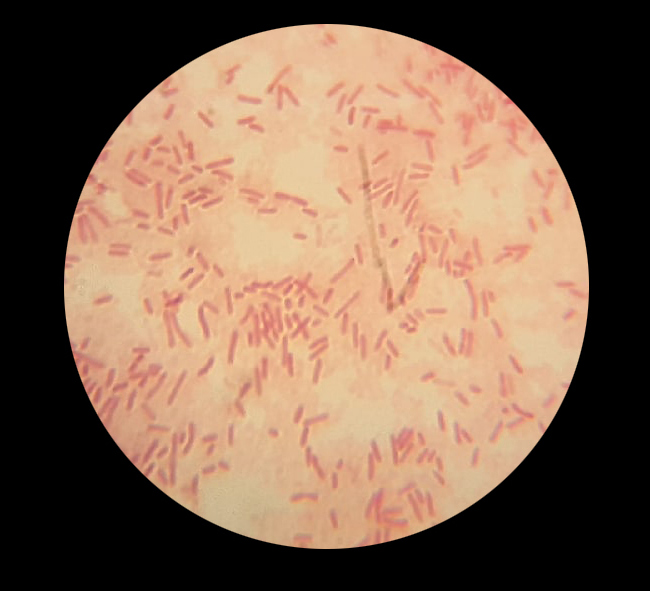
Image source: Wikipedia/Wikimedia
| Ecology, Host, and Life Cycle | |
|---|---|
| Oxygen requirements | Microaerophilic |
| Optimal temperature | 37 |
| Temperature range | Mesophilic |
| Habitat | HostAssociated |
| Biotic relationship | Free living |
| Host(s) | Not Available |
| Cell arrangement | Chains - Singles |
| Sporulation | Not Available |
| Energy source | Chemoorganotroph |
| Pathogenicity | Not Available |
Gene Summary
Adenine Count
1299590 bp
Thymine Count
1304020 bp
Guanine Count
1411109 bp
Cytosine Count
1380561 bp
Genome Length
5395280 bp
Protein-coding Genes
4871 genes
Non-Coding Genes
546 genes
# of Chromosomes/Plasmids
1
Genes
| Name | Locus Tag | UniProt ID | Strand Orientation | Gene Start/End | Protein Molecular Weight |
|---|---|---|---|---|---|
| electron transport complex subunit e | LFZ16_RS10125 | Not Available | Negative | 1988812 - 1989504 | 24319.5 |
| electron transport complex subunit rsxg | LFZ16_RS10130 | Not Available | Negative | 1989507 - 1990127 | 22225.4 |
| electron transport complex subunit rsxd | LFZ16_RS10135 | Not Available | Negative | 1990131 - 1991189 | 38292.6 |
| electron transport complex subunit rsxc | LFZ16_RS10140 | Not Available | Negative | 1991190 - 1993397 | 78656.2 |
| electron transport complex subunit rsxb | LFZ16_RS10145 | Not Available | Negative | 1993390 - 1993968 | 20678.2 |
| electron transport complex subunit rsxa | LFZ16_RS10150 | Not Available | Negative | 1993968 - 1994549 | 20894.8 |
| duf2569 domain-containing protein | LFZ16_RS10155 | Not Available | Negative | 1994626 - 1995066 | 16357.7 |
| transcription modulator ydgt | LFZ16_RS10160 | Not Available | Negative | 1995155 - 1995370 | 8381.04 |
| division septum protein blr | LFZ16_RS10165 | Not Available | Negative | 1995668 - 1995793 | 4585.71 |
| oxidoreductase | LFZ16_RS10170 | Not Available | Positive | 1996001 - 1997041 | 38408.8 |
Pathways
0 pathways
No pathways found
No metabolic pathways have been associated with this bacterium yet.
Health Effects
No health effects information available for this bacterium.