Kingdom
Pseudomonadati
Phylum
Pseudomonadota
Class
Alphaproteobacteria
Order
Rickettsiales
Family
Anaplasmataceae
Genus
Wolbachia
Description
Taxonomy
| Kingdom | Pseudomonadati |
|---|---|
| Phylum | Pseudomonadota |
| Class | Alphaproteobacteria |
| Order | Rickettsiales |
| Family | Anaplasmataceae |
| Genus | Wolbachia |
| Species | Wolbachia endosymbiont of Drosophila simulans |
| Strain | wNo |
Profile
| Physiology | |
|---|---|
| Gram staining properties | Negative |
| Shape | Bacilli |
| Mobility | Not Available |
| Flagellar presence | Yes |
| Number of membranes | Not Available |

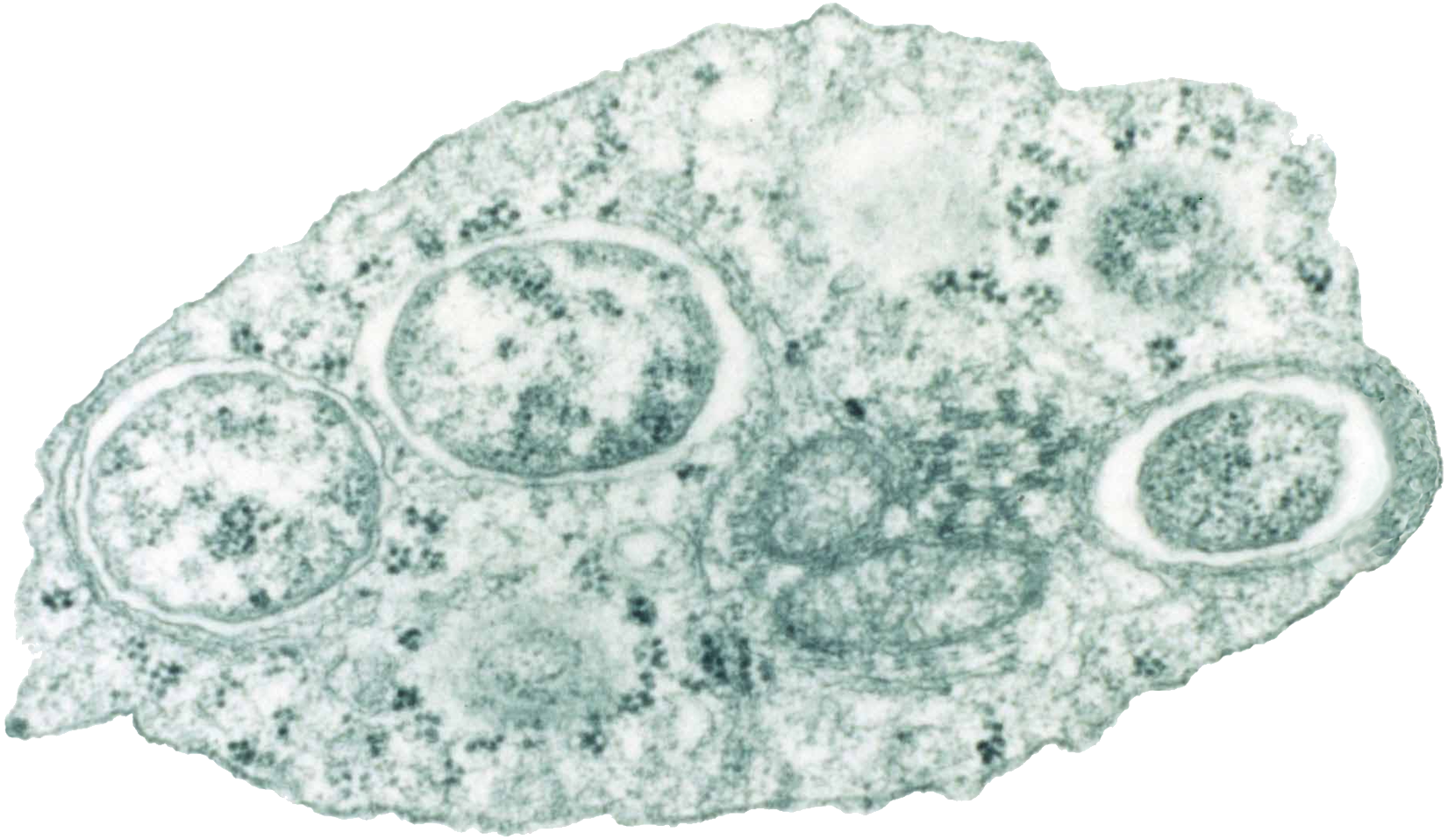
Image source: Wikipedia/Wikimedia
| Ecology, Host, and Life Cycle | |
|---|---|
| Oxygen requirements | Not Available |
| Optimal temperature | Not Available |
| Temperature range | Not Available |
| Habitat | Not Available |
| Biotic relationship | Not Available |
| Host(s) | Not Available |
| Cell arrangement | Not Available |
| Sporulation | Not Available |
| Energy source | Not Available |
| Pathogenicity | Not Available |
Gene Summary
Adenine Count
430622 bp
Thymine Count
428443 bp
Guanine Count
225996 bp
Cytosine Count
216762 bp
Genome Length
1301823 bp
Protein-coding Genes
1137 genes
Non-Coding Genes
91 genes
# of Chromosomes/Plasmids
1
Genes
| Name | Locus Tag | UniProt ID | Strand Orientation | Gene Start/End | Protein Molecular Weight |
|---|---|---|---|---|---|
| 5-aminolevulinate synthase | WNO_RS02290 | Not Available | Positive | 513025 - 514221 | 44030.9 |
| inositol monophosphatase family protein | WNO_RS02295 | Not Available | Negative | 514510 - 515202 | 25922.3 |
| elongation factor p | WNO_RS02300 | Not Available | Negative | 515203 - 515769 | 21342.6 |
| ribosome maturation factor rimm | WNO_RS02305 | Not Available | Negative | 515829 - 516329 | 19001.1 |
| dead/deah box helicase family protein | WNO_RS06765 | Not Available | Positive | 516427 - 516747 | 11680.9 |
| hypothetical protein | WNO_RS02310 | Not Available | Positive | 516744 - 520076 | 127121.0 |
| aspartate aminotransferase family protein | WNO_RS02315 | Not Available | Negative | 520073 - 521242 | 42875.9 |
| sensor histidine kinase | WNO_RS02320 | Not Available | Positive | 521307 - 522734 | 54649.9 |
| hypothetical protein | WNO_RS02325 | Not Available | Positive | 522911 - 523648 | 29085.9 |
| trna (adenosine(37)-n6)-threonylcarbamoyltransferase complex transferase subunit tsad | WNO_RS02330 | Not Available | Positive | 523721 - 524731 | 36789.0 |
Pathways
0 pathways
No pathways found
No metabolic pathways have been associated with this bacterium yet.
Health Effects
No health effects information available for this bacterium.