Kingdom
Pseudomonadati
Phylum
Campylobacterota
Class
Epsilonproteobacteria
Order
Campylobacterales
Family
Helicobacteraceae
Genus
Helicobacter
Description
Taxonomy
| Kingdom | Pseudomonadati |
|---|---|
| Phylum | Campylobacterota |
| Class | Epsilonproteobacteria |
| Order | Campylobacterales |
| Family | Helicobacteraceae |
| Genus | Helicobacter |
| Species | Helicobacter pylori |
| Strain | A45 |
Profile
| Physiology | |
|---|---|
| Gram staining properties | Negative |
| Shape | Spirilla |
| Mobility | No |
| Flagellar presence | Yes |
| Number of membranes | 2 |

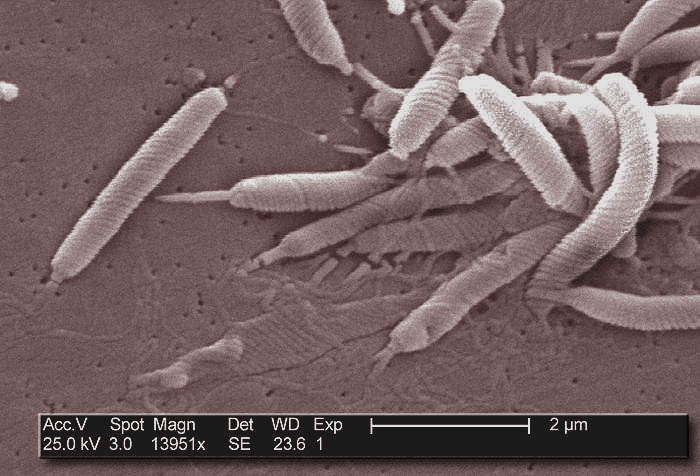
Image source: Wikipedia/Wikimedia
| Ecology, Host, and Life Cycle | |
|---|---|
| Oxygen requirements | Microaerophilic |
| Optimal temperature | 37 |
| Temperature range | Mesophilic |
| Habitat | HostAssociated |
| Biotic relationship | Free living |
| Host(s) | Not Available |
| Cell arrangement | Singles |
| Sporulation | Not Available |
| Energy source | Not Available |
| Pathogenicity | Not Available |
Gene Summary
Adenine Count
512350 bp
Thymine Count
507400 bp
Guanine Count
319299 bp
Cytosine Count
323688 bp
Genome Length
1662737 bp
Protein-coding Genes
1552 genes
Non-Coding Genes
45 genes
# of Chromosomes/Plasmids
2
Genes
| Name | Locus Tag | UniProt ID | Strand Orientation | Gene Start/End | Protein Molecular Weight |
|---|---|---|---|---|---|
| ompp1/fadl family transporter | C528_RS03415 | Not Available | Negative | 728860 - 730623 | 63652.2 |
| hypothetical protein | C528_RS03420 | Not Available | Negative | 730620 - 731237 | 24397.4 |
| lpp20 family lipoprotein | C528_RS03425 | Not Available | Negative | 731257 - 731862 | 21935.8 |
| Trna-arg | Not Available | Not Available | Positive | 732455 - 732531 | Not Available |
| hu family dna-binding protein | C528_RS03435 | Not Available | Negative | 732589 - 732873 | 10382.4 |
| ribosome biogenesis gtpase der | C528_RS03440 | Not Available | Negative | 733010 - 734395 | 51714.0 |
| hypothetical protein | C528_RS03445 | Not Available | Positive | 734472 - 735353 | 34058.3 |
| spermidine synthase | C528_RS03450 | Not Available | Positive | 735444 - 736232 | 30568.3 |
| dephospho-coa kinase | C528_RS03455 | Not Available | Positive | 736234 - 736824 | 22652.9 |
| asp-trna(asn)/glu-trna(gln) amidotransferase subunit gata | C528_RS03460 | Not Available | Positive | 736883 - 738244 | 49636.5 |
Pathways
0 pathways
No pathways found
No metabolic pathways have been associated with this bacterium yet.
Health Effects
No health effects information available for this bacterium.