
Kingdom
Pseudomonadati
Phylum
Spirochaetota
Class
Leptospiria
Order
Leptospirales
Family
Leptospiraceae
Genus
Leptospira
Description
Taxonomy
| Kingdom | Pseudomonadati |
|---|---|
| Phylum | Spirochaetota |
| Class | Leptospiria |
| Order | Leptospirales |
| Family | Leptospiraceae |
| Genus | Leptospira |
| Species | Leptospira wolbachii |
| Strain | serovar Codice CDC |
Profile
| Physiology | |
|---|---|
| Gram staining properties | Not Available |
| Shape | Not Available |
| Mobility | Not Available |
| Flagellar presence | Yes |
| Number of membranes | Not Available |
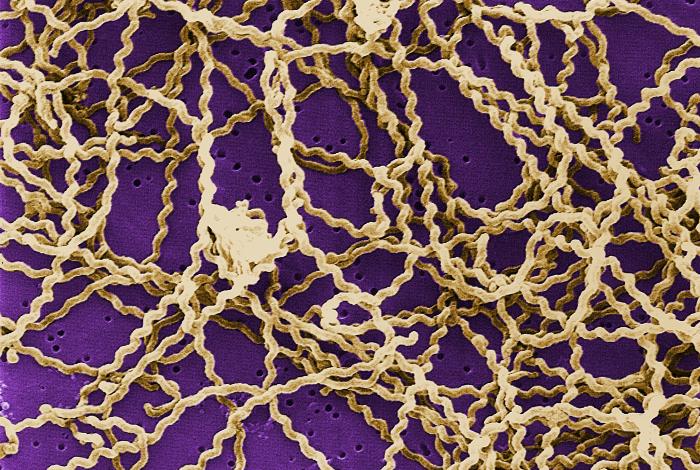
Image source: Wikipedia/Wikimedia
| Ecology, Host, and Life Cycle | |
|---|---|
| Oxygen requirements | Not Available |
| Optimal temperature | Not Available |
| Temperature range | Not Available |
| Habitat | Not Available |
| Biotic relationship | Not Available |
| Host(s) | Not Available |
| Cell arrangement | Not Available |
| Sporulation | Not Available |
| Energy source | Not Available |
| Pathogenicity | Not Available |
Gene Summary
Adenine Count
1251978 bp
Thymine Count
1231842 bp
Guanine Count
787866 bp
Cytosine Count
810295 bp
Genome Length
4081981 bp
Protein-coding Genes
3912 genes
Non-Coding Genes
44 genes
# of Chromosomes/Plasmids
1
Genes
| Name | Locus Tag | UniProt ID | Strand Orientation | Gene Start/End | Protein Molecular Weight |
|---|---|---|---|---|---|
| ybbr-like protein | LEP1GSC195_2589 | Not Available | Negative | 2289508 - 2290554 | 38267.2 |
| tigr00159 family protein | LEP1GSC195_2590 | Not Available | Negative | 2290551 - 2291381 | 30855.1 |
| dihydrodipicolinate reductase | LEP1GSC195_2591 | Not Available | Negative | 2291383 - 2292186 | 28993.0 |
| 4-hydroxy-tetrahydrodipicolinate synthase | LEP1GSC195_2592 | Not Available | Negative | 2292179 - 2293063 | 31880.5 |
| glycosyltransferase, group 4 family | LEP1GSC195_2593 | Not Available | Positive | 2293141 - 2294208 | 40925.3 |
| pf04018 domain protein | LEP1GSC195_2594 | Not Available | Positive | 2294236 - 2295219 | 35803.3 |
| putative membrane protein | LEP1GSC195_2595 | Not Available | Negative | 2295430 - 2296899 | 53583.1 |
| hypothetical protein | LEP1GSC195_2596 | Not Available | Positive | 2297236 - 2297637 | 15510.4 |
| hypothetical protein | LEP1GSC195_2597 | Not Available | Positive | 2297667 - 2298443 | 29065.5 |
| cytochrome c-type biogenesis protein ccme | LEP1GSC195_2598 | Not Available | Positive | 2298544 - 2298936 | 14320.2 |
Pathways
0 pathways
No pathways found
No metabolic pathways have been associated with this bacterium yet.
Health Effects
No health effects information available for this bacterium.


