
Kingdom
Pseudomonadati
Phylum
Spirochaetota
Class
Leptospiria
Order
Leptospirales
Family
Leptospiraceae
Genus
Leptospira
Description
Taxonomy
| Kingdom | Pseudomonadati |
|---|---|
| Phylum | Spirochaetota |
| Class | Leptospiria |
| Order | Leptospirales |
| Family | Leptospiraceae |
| Genus | Leptospira |
| Species | Leptospira wolbachii |
| Strain | serovar Codice CDC |
Profile
| Physiology | |
|---|---|
| Gram staining properties | Not Available |
| Shape | Not Available |
| Mobility | Not Available |
| Flagellar presence | Yes |
| Number of membranes | Not Available |
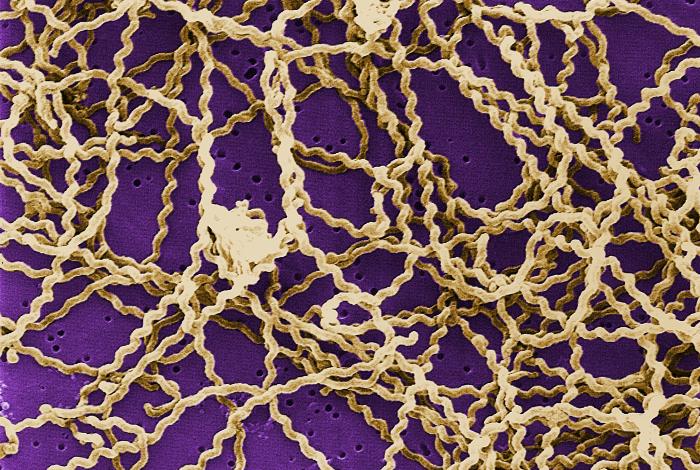
Image source: Wikipedia/Wikimedia
| Ecology, Host, and Life Cycle | |
|---|---|
| Oxygen requirements | Not Available |
| Optimal temperature | Not Available |
| Temperature range | Not Available |
| Habitat | Not Available |
| Biotic relationship | Not Available |
| Host(s) | Not Available |
| Cell arrangement | Not Available |
| Sporulation | Not Available |
| Energy source | Not Available |
| Pathogenicity | Not Available |
Gene Summary
Adenine Count
1251978 bp
Thymine Count
1231842 bp
Guanine Count
787866 bp
Cytosine Count
810295 bp
Genome Length
4081981 bp
Protein-coding Genes
3912 genes
Non-Coding Genes
44 genes
# of Chromosomes/Plasmids
1
Genes
| Name | Locus Tag | UniProt ID | Strand Orientation | Gene Start/End | Protein Molecular Weight |
|---|---|---|---|---|---|
| antidote-toxin recognition maze | LEP1GSC195_2579 | Not Available | Negative | 2279568 - 2279762 | 7362.24 |
| hypothetical protein | LEP1GSC195_2580 | Not Available | Negative | 2279902 - 2280396 | 19429.4 |
| haloacid dehalogenase-like hydrolase | LEP1GSC195_2581 | Not Available | Negative | 2280400 - 2281047 | 25590.3 |
| transcriptional regulator, tetr family | LEP1GSC195_2582 | Not Available | Negative | 2281120 - 2281770 | 24723.7 |
| aminotransferase, class iii | LEP1GSC195_2583 | Not Available | Positive | 2281933 - 2283402 | 53758.1 |
| pemk-like protein | LEP1GSC195_2584 | Not Available | Negative | 2283459 - 2283782 | 12194.2 |
| antidote-toxin recognition maze | LEP1GSC195_2585 | Not Available | Negative | 2283776 - 2284024 | 9511.44 |
| flagellar m-ring protein flif | LEP1GSC195_2586 | Not Available | Positive | 2284171 - 2285871 | 65030.9 |
| adenylate/guanylate cyclase catalytic domain protein | LEP1GSC195_2587 | Not Available | Negative | 2285873 - 2288434 | 96752.4 |
| alpha/beta hydrolase family protein | LEP1GSC195_2588 | Not Available | Positive | 2288512 - 2289408 | 34955.3 |
Pathways
0 pathways
No pathways found
No metabolic pathways have been associated with this bacterium yet.
Health Effects
No health effects information available for this bacterium.


