Kingdom
Pseudomonadati
Phylum
Campylobacterota
Class
Epsilonproteobacteria
Order
Campylobacterales
Family
Helicobacteraceae
Genus
Helicobacter
Description
Taxonomy
| Kingdom | Pseudomonadati |
|---|---|
| Phylum | Campylobacterota |
| Class | Epsilonproteobacteria |
| Order | Campylobacterales |
| Family | Helicobacteraceae |
| Genus | Helicobacter |
| Species | Helicobacter pylori |
| Strain | FD719 |
Profile
| Physiology | |
|---|---|
| Gram staining properties | Negative |
| Shape | Spirilla |
| Mobility | No |
| Flagellar presence | Yes |
| Number of membranes | 2 |

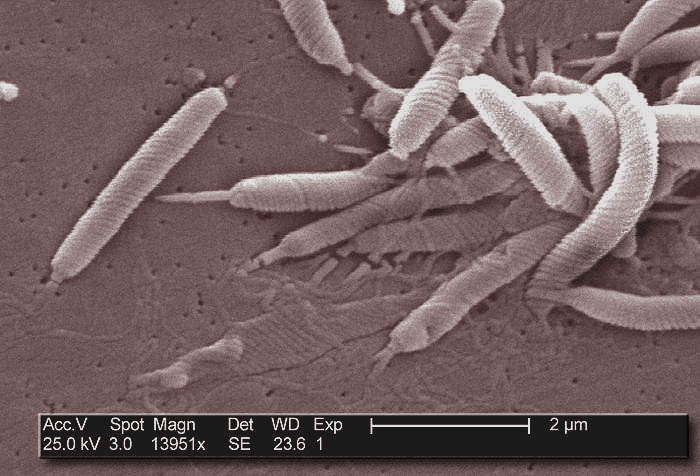
Image source: Wikipedia/Wikimedia
| Ecology, Host, and Life Cycle | |
|---|---|
| Oxygen requirements | Microaerophilic |
| Optimal temperature | 37 |
| Temperature range | Mesophilic |
| Habitat | HostAssociated |
| Biotic relationship | Free living |
| Host(s) | Not Available |
| Cell arrangement | Singles |
| Sporulation | Not Available |
| Energy source | Not Available |
| Pathogenicity | Not Available |
Gene Summary
Adenine Count
504732 bp
Thymine Count
495339 bp
Guanine Count
326881 bp
Cytosine Count
315192 bp
Genome Length
1642171 bp
Protein-coding Genes
1592 genes
Non-Coding Genes
64 genes
# of Chromosomes/Plasmids
1
Genes
| Name | Locus Tag | UniProt ID | Strand Orientation | Gene Start/End | Protein Molecular Weight |
|---|---|---|---|---|---|
| hypothetical protein | N409_03385 | Not Available | Negative | 518064 - 518411 | 13262.3 |
| atp-dependent dna helicase recg | N409_03390 | Not Available | Positive | 518493 - 520364 | 71430.1 |
| type ii restriction endonuclease | N409_03395 | Not Available | Positive | 520407 - 522383 | 75310.7 |
| dead/deah box helicase | N409_03400 | Not Available | Positive | 522386 - 525295 | 112282.0 |
| type ii restriction endonuclease | N409_03405 | Not Available | Positive | 525401 - 529273 | 150827.0 |
| hypothetical protein | N409_03410 | Not Available | Negative | 529333 - 529425 | 3716.7 |
| transcription elongation factor nusa | N409_03415 | Not Available | Negative | 529599 - 530810 | 45570.4 |
| selenocysteine synthase | N409_03420 | Not Available | Negative | 530905 - 532065 | 43983.6 |
| tonb-dependent receptor | N409_03425 | Not Available | Negative | 532287 - 534920 | 97432.0 |
| iron-regulated outer membrane protein frpb4 | N409_03430 | Not Available | Negative | 535112 - 535411 | 11579.0 |
Pathways
0 pathways
No pathways found
No metabolic pathways have been associated with this bacterium yet.
Health Effects
No health effects information available for this bacterium.