Kingdom
Pseudomonadati
Phylum
Campylobacterota
Class
Epsilonproteobacteria
Order
Campylobacterales
Family
Helicobacteraceae
Genus
Helicobacter
Description
Taxonomy
| Kingdom | Pseudomonadati |
|---|---|
| Phylum | Campylobacterota |
| Class | Epsilonproteobacteria |
| Order | Campylobacterales |
| Family | Helicobacteraceae |
| Genus | Helicobacter |
| Species | Helicobacter pylori |
| Strain | FD719 |
Profile
| Physiology | |
|---|---|
| Gram staining properties | Negative |
| Shape | Spirilla |
| Mobility | No |
| Flagellar presence | Yes |
| Number of membranes | 2 |

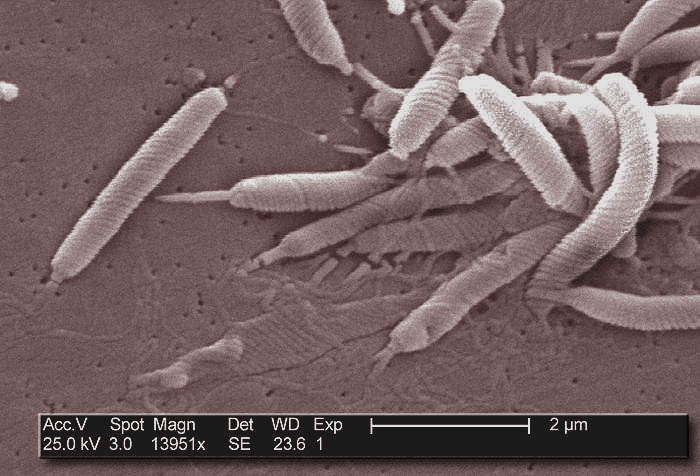
Image source: Wikipedia/Wikimedia
| Ecology, Host, and Life Cycle | |
|---|---|
| Oxygen requirements | Microaerophilic |
| Optimal temperature | 37 |
| Temperature range | Mesophilic |
| Habitat | HostAssociated |
| Biotic relationship | Free living |
| Host(s) | Not Available |
| Cell arrangement | Singles |
| Sporulation | Not Available |
| Energy source | Not Available |
| Pathogenicity | Not Available |
Gene Summary
Adenine Count
504732 bp
Thymine Count
495339 bp
Guanine Count
326881 bp
Cytosine Count
315192 bp
Genome Length
1642171 bp
Protein-coding Genes
1592 genes
Non-Coding Genes
64 genes
# of Chromosomes/Plasmids
1
Genes
| Name | Locus Tag | UniProt ID | Strand Orientation | Gene Start/End | Protein Molecular Weight |
|---|---|---|---|---|---|
| membrane protein | N409_03155 | Not Available | Positive | 476737 - 478272 | 57959.7 |
| oxidoreductase | N409_03160 | Not Available | Positive | 478294 - 479046 | 27773.7 |
| beta-lactamase | N409_03175 | Not Available | Negative | 479248 - 480036 | 28511.9 |
| ketohydroxyglutarate aldolase | N409_03180 | Not Available | Negative | 480106 - 480732 | 22585.9 |
| phosphogluconate dehydratase | N409_03185 | Not Available | Negative | 480751 - 482577 | 66695.8 |
| glucose-6-phosphate 1-dehydrogenase | N409_03190 | Not Available | Positive | 482643 - 483920 | 49514.6 |
| 6-phosphogluconolactonase | N409_03195 | Not Available | Positive | 483931 - 484614 | 25698.9 |
| glucokinase | N409_03200 | Not Available | Positive | 484601 - 485611 | 36733.8 |
| nadp-dependent alcohol dehydrogenase | N409_03205 | Not Available | Positive | 485781 - 486827 | 38495.6 |
| lps biosynthesis protein | N409_03210 | Not Available | Negative | 486839 - 488035 | 46739.0 |
Pathways
0 pathways
No pathways found
No metabolic pathways have been associated with this bacterium yet.
Health Effects
No health effects information available for this bacterium.