Kingdom
Pseudomonadati
Phylum
Campylobacterota
Class
Epsilonproteobacteria
Order
Campylobacterales
Family
Helicobacteraceae
Genus
Helicobacter
Description
Taxonomy
| Kingdom | Pseudomonadati |
|---|---|
| Phylum | Campylobacterota |
| Class | Epsilonproteobacteria |
| Order | Campylobacterales |
| Family | Helicobacteraceae |
| Genus | Helicobacter |
| Species | Helicobacter pylori |
| Strain | FD719 |
Profile
| Physiology | |
|---|---|
| Gram staining properties | Negative |
| Shape | Spirilla |
| Mobility | No |
| Flagellar presence | Yes |
| Number of membranes | 2 |

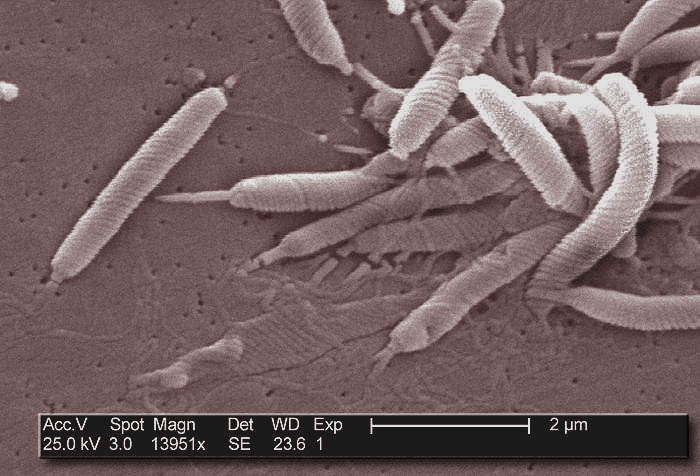
Image source: Wikipedia/Wikimedia
| Ecology, Host, and Life Cycle | |
|---|---|
| Oxygen requirements | Microaerophilic |
| Optimal temperature | 37 |
| Temperature range | Mesophilic |
| Habitat | HostAssociated |
| Biotic relationship | Free living |
| Host(s) | Not Available |
| Cell arrangement | Singles |
| Sporulation | Not Available |
| Energy source | Not Available |
| Pathogenicity | Not Available |
Gene Summary
Adenine Count
504732 bp
Thymine Count
495339 bp
Guanine Count
326881 bp
Cytosine Count
315192 bp
Genome Length
1642171 bp
Protein-coding Genes
1592 genes
Non-Coding Genes
64 genes
# of Chromosomes/Plasmids
1
Genes
| Name | Locus Tag | UniProt ID | Strand Orientation | Gene Start/End | Protein Molecular Weight |
|---|---|---|---|---|---|
| type i restriction endonuclease subunit s | N409_02645 | Not Available | Negative | 383899 - 385149 | 47943.8 |
| n-6 dna methylase | N409_02650 | Not Available | Negative | 385142 - 386773 | 62208.9 |
| restriction endonuclease subunit r | N409_02655 | Not Available | Negative | 389299 - 389934 | 24567.1 |
| hypothetical protein | N409_02660 | Not Available | Negative | 389982 - 391877 | 72603.0 |
| tellurite resistance terb family protein | N409_02665 | Not Available | Negative | 391904 - 392671 | 29719.5 |
| membrane protein | N409_02670 | Not Available | Negative | 392681 - 392995 | 12510.4 |
| hypothetical protein | N409_02675 | Not Available | Negative | 392997 - 394484 | 57529.1 |
| hypothetical protein | N409_02680 | Not Available | Negative | 394496 - 394984 | 18665.4 |
| oligoendopeptidase f | N409_02685 | Not Available | Negative | 394969 - 396705 | 67657.8 |
| potassium transporter | N409_02690 | Not Available | Negative | 396802 - 398052 | 46080.6 |
Pathways
0 pathways
No pathways found
No metabolic pathways have been associated with this bacterium yet.
Health Effects
No health effects information available for this bacterium.