Kingdom
Pseudomonadati
Phylum
Campylobacterota
Class
Epsilonproteobacteria
Order
Campylobacterales
Family
Helicobacteraceae
Genus
Helicobacter
Description
Taxonomy
| Kingdom | Pseudomonadati |
|---|---|
| Phylum | Campylobacterota |
| Class | Epsilonproteobacteria |
| Order | Campylobacterales |
| Family | Helicobacteraceae |
| Genus | Helicobacter |
| Species | Helicobacter pylori |
| Strain | FD719 |
Profile
| Physiology | |
|---|---|
| Gram staining properties | Negative |
| Shape | Spirilla |
| Mobility | No |
| Flagellar presence | Yes |
| Number of membranes | 2 |

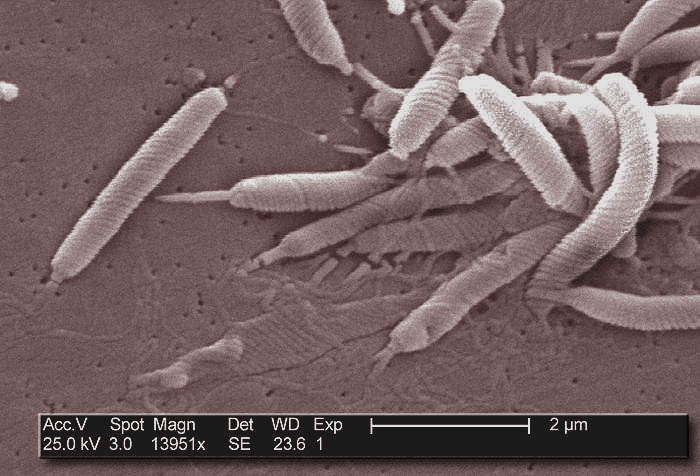
Image source: Wikipedia/Wikimedia
| Ecology, Host, and Life Cycle | |
|---|---|
| Oxygen requirements | Microaerophilic |
| Optimal temperature | 37 |
| Temperature range | Mesophilic |
| Habitat | HostAssociated |
| Biotic relationship | Free living |
| Host(s) | Not Available |
| Cell arrangement | Singles |
| Sporulation | Not Available |
| Energy source | Not Available |
| Pathogenicity | Not Available |
Gene Summary
Adenine Count
504732 bp
Thymine Count
495339 bp
Guanine Count
326881 bp
Cytosine Count
315192 bp
Genome Length
1642171 bp
Protein-coding Genes
1592 genes
Non-Coding Genes
64 genes
# of Chromosomes/Plasmids
1
Genes
| Name | Locus Tag | UniProt ID | Strand Orientation | Gene Start/End | Protein Molecular Weight |
|---|---|---|---|---|---|
| carboxylate transporter | N409_00245 | Not Available | Negative | 275461 - 276878 | 50890.0 |
| flagellar l-ring protein flgh | N409_02080 | Not Available | Positive | 276879 - 277535 | 24396.6 |
| cmp-n-acetylneuraminic acid synthetase | N409_02085 | Not Available | Positive | 277553 - 278236 | 25892.3 |
| cmp-n-acetylneuraminic acid synthetase | N409_02090 | Not Available | Positive | 278227 - 279099 | 33022.9 |
| flagellar protein flag | N409_02095 | Not Available | Positive | 279096 - 279638 | 21415.8 |
| tetraacyldisaccharide 4'-kinase | N409_02100 | Not Available | Negative | 279571 - 280509 | 35477.7 |
| nad synthetase | N409_02105 | Not Available | Negative | 280506 - 281288 | 29126.4 |
| Trna-arg | Not Available | Not Available | Positive | 281373 - 281449 | Not Available |
| septum site-determining protein mind | N409_02120 | Not Available | Positive | 282553 - 283359 | 29297.8 |
| cell division topological specificity factor | N409_02125 | Not Available | Positive | 283356 - 283589 | 8892.88 |
Pathways
0 pathways
No pathways found
No metabolic pathways have been associated with this bacterium yet.
Health Effects
No health effects information available for this bacterium.