Kingdom
Pseudomonadati
Phylum
Campylobacterota
Class
Epsilonproteobacteria
Order
Campylobacterales
Family
Helicobacteraceae
Genus
Helicobacter
Description
Taxonomy
| Kingdom | Pseudomonadati |
|---|---|
| Phylum | Campylobacterota |
| Class | Epsilonproteobacteria |
| Order | Campylobacterales |
| Family | Helicobacteraceae |
| Genus | Helicobacter |
| Species | Helicobacter pylori |
| Strain | FD719 |
Profile
| Physiology | |
|---|---|
| Gram staining properties | Negative |
| Shape | Spirilla |
| Mobility | No |
| Flagellar presence | Yes |
| Number of membranes | 2 |

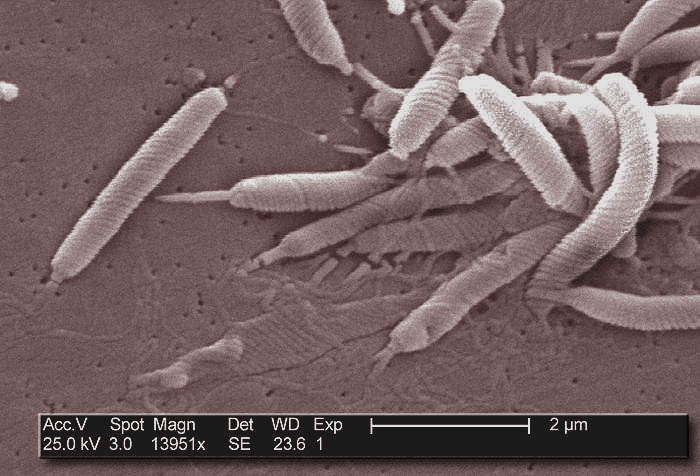
Image source: Wikipedia/Wikimedia
| Ecology, Host, and Life Cycle | |
|---|---|
| Oxygen requirements | Microaerophilic |
| Optimal temperature | 37 |
| Temperature range | Mesophilic |
| Habitat | HostAssociated |
| Biotic relationship | Free living |
| Host(s) | Not Available |
| Cell arrangement | Singles |
| Sporulation | Not Available |
| Energy source | Not Available |
| Pathogenicity | Not Available |
Gene Summary
Adenine Count
504732 bp
Thymine Count
495339 bp
Guanine Count
326881 bp
Cytosine Count
315192 bp
Genome Length
1642171 bp
Protein-coding Genes
1592 genes
Non-Coding Genes
64 genes
# of Chromosomes/Plasmids
1
Genes
| Name | Locus Tag | UniProt ID | Strand Orientation | Gene Start/End | Protein Molecular Weight |
|---|---|---|---|---|---|
| guanosine polyphosphate pyrophosphohydrolase | N409_01840 | Not Available | Positive | 191510 - 192964 | 54383.6 |
| glycosyl transferase family 1 | N409_01845 | Not Available | Positive | 192961 - 193971 | 38062.9 |
| lauroyl acyltransferase | N409_01850 | Not Available | Positive | 193968 - 194954 | 38444.5 |
| queuine trna-ribosyltransferase | N409_01855 | Not Available | Negative | 195134 - 196249 | 41517.0 |
| potassium transporter trka | N409_01860 | Not Available | Positive | 196306 - 196906 | 23240.4 |
| potassium transporter trka | N409_01865 | Not Available | Positive | 196907 - 197722 | 31832.6 |
| 3-dehydroquinate synthase | N409_01870 | Not Available | Positive | 197727 - 198758 | 39008.0 |
| membrane protein | N409_01875 | Not Available | Positive | 198749 - 200320 | 60063.4 |
| radical sam protein | N409_01880 | Not Available | Positive | 200317 - 201573 | 47744.6 |
| cell division protein fsth | N409_01885 | Not Available | Positive | 201560 - 203212 | 62965.7 |
Pathways
0 pathways
No pathways found
No metabolic pathways have been associated with this bacterium yet.
Health Effects
No health effects information available for this bacterium.