Kingdom
Pseudomonadati
Phylum
Campylobacterota
Class
Epsilonproteobacteria
Order
Campylobacterales
Family
Helicobacteraceae
Genus
Helicobacter
Description
Taxonomy
| Kingdom | Pseudomonadati |
|---|---|
| Phylum | Campylobacterota |
| Class | Epsilonproteobacteria |
| Order | Campylobacterales |
| Family | Helicobacteraceae |
| Genus | Helicobacter |
| Species | Helicobacter pylori |
| Strain | FD577 |
Profile
| Physiology | |
|---|---|
| Gram staining properties | Negative |
| Shape | Spirilla |
| Mobility | No |
| Flagellar presence | Yes |
| Number of membranes | 2 |

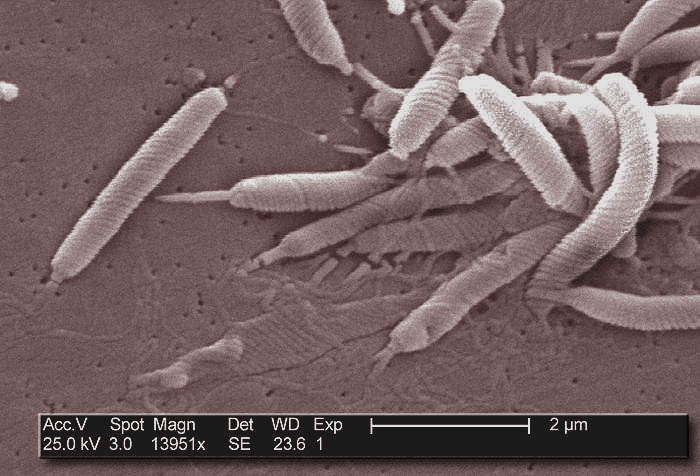
Image source: Wikipedia/Wikimedia
| Ecology, Host, and Life Cycle | |
|---|---|
| Oxygen requirements | Microaerophilic |
| Optimal temperature | 37 |
| Temperature range | Mesophilic |
| Habitat | HostAssociated |
| Biotic relationship | Free living |
| Host(s) | Not Available |
| Cell arrangement | Singles |
| Sporulation | Not Available |
| Energy source | Not Available |
| Pathogenicity | Not Available |
Gene Summary
Adenine Count
498079 bp
Thymine Count
499139 bp
Guanine Count
317528 bp
Cytosine Count
311136 bp
Genome Length
1625905 bp
Protein-coding Genes
1602 genes
Non-Coding Genes
43 genes
# of Chromosomes/Plasmids
1
Genes
| Name | Locus Tag | UniProt ID | Strand Orientation | Gene Start/End | Protein Molecular Weight |
|---|---|---|---|---|---|
| rna methyltransferase | N406_05445 | Not Available | Negative | 675770 - 676372 | 22555.8 |
| dihydroneopterin aldolase | N406_05450 | Not Available | Negative | 676351 - 676677 | 12796.6 |
| hypothetical protein | N406_05455 | Not Available | Negative | 676801 - 676929 | 5091.65 |
| sam-dependent methyltransferase | N406_05460 | Not Available | Negative | 677119 - 678126 | 38570.8 |
| metallo-beta-lactamase | N406_05465 | Not Available | Positive | 678258 - 678875 | 23583.1 |
| thiamin biosynthesis protein (thif) | N406_05470 | Not Available | Positive | 678876 - 679643 | 28192.6 |
| flagellar motor protein mota | N406_05475 | Not Available | Positive | 679659 - 680432 | 27711.9 |
| flagellar motor protein motb | N406_05480 | Not Available | Positive | 680435 - 681202 | 28585.2 |
| hypothetical protein | N406_05485 | Not Available | Positive | 681206 - 681643 | 16705.2 |
| osmoprotection protein (prowx) | N406_05490 | Not Available | Positive | 681820 - 683385 | 58916.9 |
Pathways
0 pathways
No pathways found
No metabolic pathways have been associated with this bacterium yet.
Health Effects
No health effects information available for this bacterium.