Kingdom
Pseudomonadati
Phylum
Campylobacterota
Class
Epsilonproteobacteria
Order
Campylobacterales
Family
Helicobacteraceae
Genus
Helicobacter
Description
Taxonomy
| Kingdom | Pseudomonadati |
|---|---|
| Phylum | Campylobacterota |
| Class | Epsilonproteobacteria |
| Order | Campylobacterales |
| Family | Helicobacteraceae |
| Genus | Helicobacter |
| Species | Helicobacter pylori |
| Strain | FD577 |
Profile
| Physiology | |
|---|---|
| Gram staining properties | Negative |
| Shape | Spirilla |
| Mobility | No |
| Flagellar presence | Yes |
| Number of membranes | 2 |

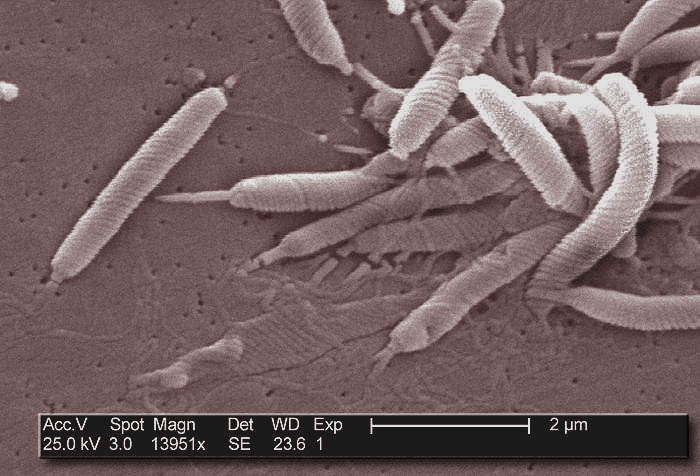
Image source: Wikipedia/Wikimedia
| Ecology, Host, and Life Cycle | |
|---|---|
| Oxygen requirements | Microaerophilic |
| Optimal temperature | 37 |
| Temperature range | Mesophilic |
| Habitat | HostAssociated |
| Biotic relationship | Free living |
| Host(s) | Not Available |
| Cell arrangement | Singles |
| Sporulation | Not Available |
| Energy source | Not Available |
| Pathogenicity | Not Available |
Gene Summary
Adenine Count
498079 bp
Thymine Count
499139 bp
Guanine Count
317528 bp
Cytosine Count
311136 bp
Genome Length
1625905 bp
Protein-coding Genes
1602 genes
Non-Coding Genes
43 genes
# of Chromosomes/Plasmids
1
Genes
| Name | Locus Tag | UniProt ID | Strand Orientation | Gene Start/End | Protein Molecular Weight |
|---|---|---|---|---|---|
| hypothetical protein | N406_05290 | Not Available | Positive | 647131 - 648420 | 49290.9 |
| membrane protein | N406_05295 | Not Available | Positive | 648514 - 649881 | 52021.7 |
| hypothetical protein | N406_05300 | Not Available | Negative | 649888 - 650415 | 19992.8 |
| Tmrna,resume consensus sequence (at 77): aataactgtaaacaacac | Not Available | Not Available | Positive | 650457 - 650842 | Not Available |
| membrane protein | N406_05305 | Not Available | Negative | 650908 - 651462 | 21418.2 |
| preprotein translocase subunit seca | N406_05310 | Not Available | Positive | 651609 - 654206 | 99060.2 |
| membrane protein | N406_05315 | Not Available | Positive | 654142 - 655428 | 47992.7 |
| membrane protein | N406_05320 | Not Available | Positive | 655710 - 657209 | 57121.5 |
| hypothetical protein | N406_05325 | Not Available | Negative | 657336 - 657431 | 3609.38 |
| type i restriction endonuclease subunit s | N406_05335 | Not Available | Negative | 657503 - 658186 | 26145.8 |
Pathways
0 pathways
No pathways found
No metabolic pathways have been associated with this bacterium yet.
Health Effects
No health effects information available for this bacterium.