Kingdom
Pseudomonadati
Phylum
Campylobacterota
Class
Epsilonproteobacteria
Order
Campylobacterales
Family
Helicobacteraceae
Genus
Helicobacter
Description
Taxonomy
| Kingdom | Pseudomonadati |
|---|---|
| Phylum | Campylobacterota |
| Class | Epsilonproteobacteria |
| Order | Campylobacterales |
| Family | Helicobacteraceae |
| Genus | Helicobacter |
| Species | Helicobacter pylori |
| Strain | FD577 |
Profile
| Physiology | |
|---|---|
| Gram staining properties | Negative |
| Shape | Spirilla |
| Mobility | No |
| Flagellar presence | Yes |
| Number of membranes | 2 |

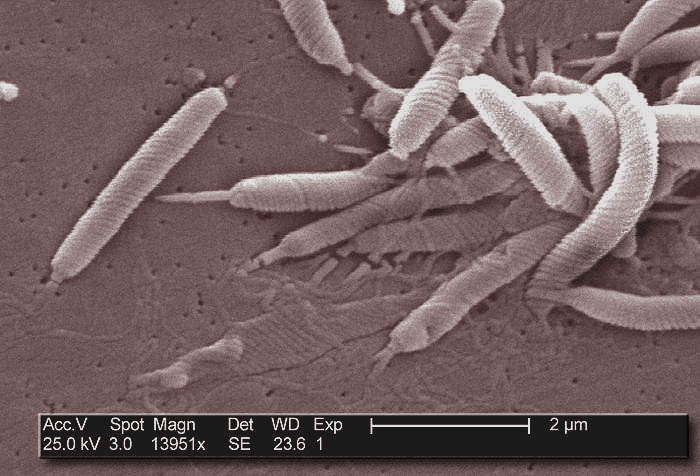
Image source: Wikipedia/Wikimedia
| Ecology, Host, and Life Cycle | |
|---|---|
| Oxygen requirements | Microaerophilic |
| Optimal temperature | 37 |
| Temperature range | Mesophilic |
| Habitat | HostAssociated |
| Biotic relationship | Free living |
| Host(s) | Not Available |
| Cell arrangement | Singles |
| Sporulation | Not Available |
| Energy source | Not Available |
| Pathogenicity | Not Available |
Gene Summary
Adenine Count
498079 bp
Thymine Count
499139 bp
Guanine Count
317528 bp
Cytosine Count
311136 bp
Genome Length
1625905 bp
Protein-coding Genes
1602 genes
Non-Coding Genes
43 genes
# of Chromosomes/Plasmids
1
Genes
| Name | Locus Tag | UniProt ID | Strand Orientation | Gene Start/End | Protein Molecular Weight |
|---|---|---|---|---|---|
| membrane protein | N406_04555 | Not Available | Negative | 518121 - 519500 | 51508.5 |
| mfs transporter | N406_04560 | Not Available | Negative | 519661 - 520836 | 43003.8 |
| hypothetical protein | N406_04565 | Not Available | Positive | 520819 - 520926 | 4060.04 |
| carbonic anhydrase | N406_04570 | Not Available | Positive | 521112 - 521855 | 28300.7 |
| hypothetical protein | N406_04575 | Not Available | Negative | 522086 - 522685 | 22727.2 |
| hypothetical protein | N406_04580 | Not Available | Negative | 522686 - 523047 | 13241.2 |
| aspartate-semialdehyde dehydrogenase | N406_04585 | Not Available | Negative | 523477 - 524517 | 38078.0 |
| histidyl-trna synthase | N406_04590 | Not Available | Negative | 524504 - 525832 | 50210.4 |
| adp-heptose--lps heptosyltransferase | N406_04595 | Not Available | Positive | 525894 - 526943 | 39472.4 |
| flagellar protein | N406_04600 | Not Available | Negative | 527145 - 527525 | 13890.9 |
Pathways
0 pathways
No pathways found
No metabolic pathways have been associated with this bacterium yet.
Health Effects
No health effects information available for this bacterium.