Kingdom
Pseudomonadati
Phylum
Campylobacterota
Class
Epsilonproteobacteria
Order
Campylobacterales
Family
Helicobacteraceae
Genus
Helicobacter
Description
Taxonomy
| Kingdom | Pseudomonadati |
|---|---|
| Phylum | Campylobacterota |
| Class | Epsilonproteobacteria |
| Order | Campylobacterales |
| Family | Helicobacteraceae |
| Genus | Helicobacter |
| Species | Helicobacter pylori |
| Strain | FD577 |
Profile
| Physiology | |
|---|---|
| Gram staining properties | Negative |
| Shape | Spirilla |
| Mobility | No |
| Flagellar presence | Yes |
| Number of membranes | 2 |

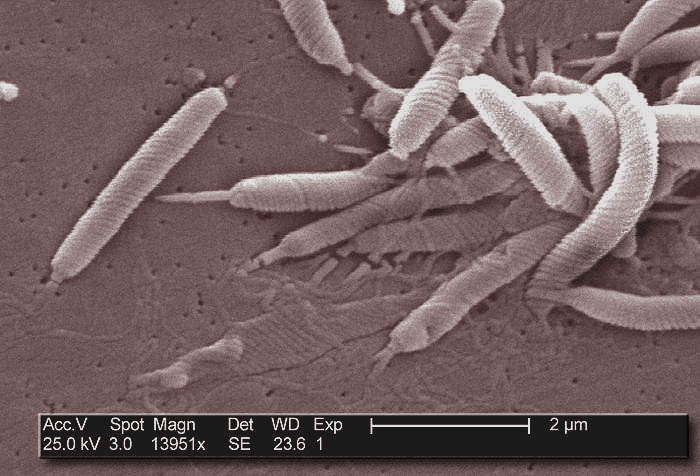
Image source: Wikipedia/Wikimedia
| Ecology, Host, and Life Cycle | |
|---|---|
| Oxygen requirements | Microaerophilic |
| Optimal temperature | 37 |
| Temperature range | Mesophilic |
| Habitat | HostAssociated |
| Biotic relationship | Free living |
| Host(s) | Not Available |
| Cell arrangement | Singles |
| Sporulation | Not Available |
| Energy source | Not Available |
| Pathogenicity | Not Available |
Gene Summary
Adenine Count
498079 bp
Thymine Count
499139 bp
Guanine Count
317528 bp
Cytosine Count
311136 bp
Genome Length
1625905 bp
Protein-coding Genes
1602 genes
Non-Coding Genes
43 genes
# of Chromosomes/Plasmids
1
Genes
| Name | Locus Tag | UniProt ID | Strand Orientation | Gene Start/End | Protein Molecular Weight |
|---|---|---|---|---|---|
| 50s ribosomal protein l17 | N406_04080 | Not Available | Positive | 425230 - 425395 | 6359.88 |
| 50s ribosomal protein l17 | N406_04085 | Not Available | Positive | 425396 - 425557 | 6126.29 |
| thiamine pyrophosphokinase | N406_04090 | Not Available | Negative | 426110 - 426724 | 22882.6 |
| nicotinamide mononucleotide transporter | N406_04095 | Not Available | Negative | 426712 - 427374 | 25478.0 |
| transcriptional regulator | N406_04100 | Not Available | Negative | 427496 - 428152 | 25216.1 |
| hypothetical protein | N406_04110 | Not Available | Negative | 428744 - 429292 | 20624.0 |
| 5'-nucleotidase | N406_04115 | Not Available | Positive | 429416 - 430153 | 27901.9 |
| glycosyltransferase 9 family protein | N406_04120 | Not Available | Positive | 430220 - 431278 | 39629.1 |
| anthranilate synthase | N406_04125 | Not Available | Positive | 431449 - 433008 | 58857.3 |
| anthranilate synthase subunit ii | N406_04130 | Not Available | Positive | 433005 - 433589 | 21416.2 |
Pathways
0 pathways
No pathways found
No metabolic pathways have been associated with this bacterium yet.
Health Effects
No health effects information available for this bacterium.