Kingdom
Pseudomonadati
Phylum
Campylobacterota
Class
Epsilonproteobacteria
Order
Campylobacterales
Family
Helicobacteraceae
Genus
Helicobacter
Description
Taxonomy
| Kingdom | Pseudomonadati |
|---|---|
| Phylum | Campylobacterota |
| Class | Epsilonproteobacteria |
| Order | Campylobacterales |
| Family | Helicobacteraceae |
| Genus | Helicobacter |
| Species | Helicobacter pylori |
| Strain | FD423 |
Profile
| Physiology | |
|---|---|
| Gram staining properties | Negative |
| Shape | Spirilla |
| Mobility | No |
| Flagellar presence | Yes |
| Number of membranes | 2 |

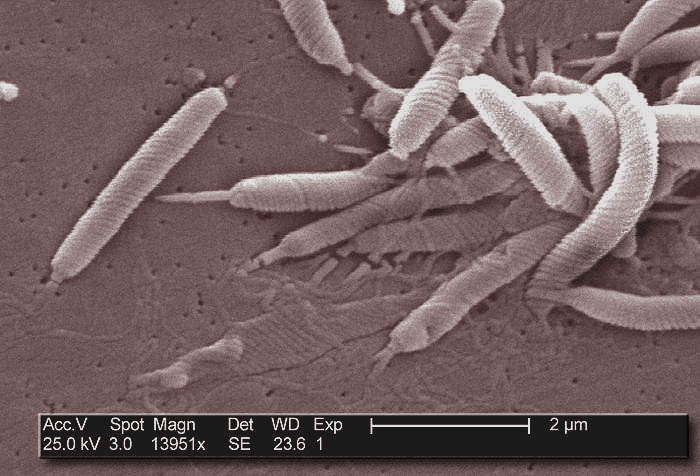
Image source: Wikipedia/Wikimedia
| Ecology, Host, and Life Cycle | |
|---|---|
| Oxygen requirements | Microaerophilic |
| Optimal temperature | 37 |
| Temperature range | Mesophilic |
| Habitat | HostAssociated |
| Biotic relationship | Free living |
| Host(s) | Not Available |
| Cell arrangement | Singles |
| Sporulation | Not Available |
| Energy source | Not Available |
| Pathogenicity | Not Available |
Gene Summary
Adenine Count
494087 bp
Thymine Count
493634 bp
Guanine Count
314904 bp
Cytosine Count
320501 bp
Genome Length
1623128 bp
Protein-coding Genes
1625 genes
Non-Coding Genes
43 genes
# of Chromosomes/Plasmids
1
Genes
| Name | Locus Tag | UniProt ID | Strand Orientation | Gene Start/End | Protein Molecular Weight |
|---|---|---|---|---|---|
| dna repair protein rada | N402_05840 | Not Available | Negative | 1009070 - 1010416 | 49500.3 |
| copg family transcriptional regulator | N402_05845 | Not Available | Negative | 1010526 - 1010759 | 8953.55 |
| nitrogen-fixing protein nifu | N402_05850 | Not Available | Negative | 1010922 - 1011902 | 36378.9 |
| cysteine desulfarase | N402_05855 | Not Available | Negative | 1011924 - 1013087 | 42407.9 |
| dna-binding protein | N402_05860 | Not Available | Negative | 1013261 - 1013743 | 18667.9 |
| phospholipid-binding protein | N402_05865 | Not Available | Positive | 1013788 - 1014420 | 23971.1 |
| beta-1,4-n-acetylgalactosamyltransferase | N402_05870 | Not Available | Negative | 1014436 - 1015146 | 28311.0 |
| beta-1,4-n-acetylgalactosaminyltransferase | N402_05875 | Not Available | Negative | 1015308 - 1015613 | 11636.1 |
| 1-deoxy-d-xylulose 5-phosphate reductoisomerase | N402_05880 | Not Available | Negative | 1015664 - 1016770 | 40139.2 |
| phosphatidate cytidylyltransferase | N402_05885 | Not Available | Negative | 1016771 - 1017571 | 28868.1 |
Pathways
0 pathways
No pathways found
No metabolic pathways have been associated with this bacterium yet.
Health Effects
No health effects information available for this bacterium.