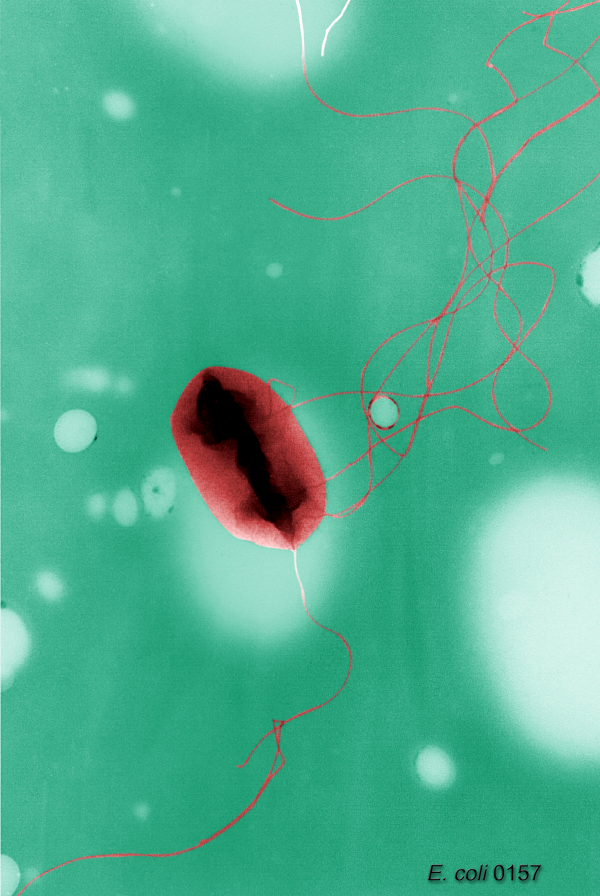
Escherichia coli KTE146

Gram-negativeRodMotileFacultative anaerobe

Kingdom

Pseudomonadati

Phylum

Pseudomonadota

Class

Gammaproteobacteria

Order

Enterobacterales

Family

Enterobacteriaceae

Genus

Escherichia

Description

Escherichia coli KTE146 is a Gram-negative, rod-shaped bacterium that exhibits mobility due to the presence of flagella. It typically resides in host-associated environments, reflecting its adaptation to living within various hosts. As a facultative anaerobe, E. coli KTE146 can thrive in both aerobic and anaerobic conditions, making it versatile in different ecological niches. The bacterium has an optimal growth temperature of 37°C and falls within the mesophilic temperature range, indicating its preference for moderate temperatures typical of warm-blooded hosts. E. coli KTE146 possesses a single replicon and features a characteristic double membrane structure, common in Gram-negative bacteria. In terms of ecological relationships, E. coli KTE146 is classified as free-living, suggesting that while it often associates with hosts, it can also exist independently in various environments. This trait highlights its adaptability and potential roles in different ecosystems, including soil and water. Overall, the ecological success of E. coli KTE146 can be attributed to its versatile metabolic capabilities, mobility, and ability to thrive in diverse conditions, which allows it to occupy various niches both within and outside host organisms. The adaptability of E. coli KTE146 underscores the significance of bacterial diversity in ecological systems. The accession number for further study of this strain is ANWM00000000.1.

Taxonomy

KingdomPseudomonadati
PhylumPseudomonadota
ClassGammaproteobacteria
OrderEnterobacterales
FamilyEnterobacteriaceae
GenusEscherichia
SpeciesEscherichia coli
StrainKTE146

Profile

Physiology
Gram staining propertiesNegative
ShapeRod
MobilityYes
Flagellar presenceYes
Number of membranes2
Image of Escherichia coli KTE146
Image source: Wikipedia/Wikimedia
Ecology, Host, and Life Cycle
Oxygen requirementsFacultative anaerobe
Optimal temperature37
Temperature rangeMesophilic
HabitatHostAssociated
Biotic relationshipFree living
Host(s)Not Available
Cell arrangementPairs - Singles
SporulationNot Available
Energy sourceNot Available
PathogenicityNot Available

Genome Summary

Escherichia coli KTE146 acASl-supercont1.9.C46, whole genome

Gene Summary

Adenine Count

1297653 bp

Thymine Count

1297588 bp

Guanine Count

1324049 bp

Cytosine Count

1324141 bp

Genome Length

5243431 bp

Protein-coding Genes

4674 genes

Non-Coding Genes

305 genes

# of Chromosomes/Plasmids

1

Genes

NameLocus TagUniProt IDStrand OrientationGene Start/EndProtein Molecular Weight
Internal virion protein dA311_01362Not AvailablePositive1456257 - 145803264622.3
hypothetical proteinA311_01363Not AvailableNegative1458033 - 145849117254.5
Repressor ciA311_01364Not AvailableNegative1458628 - 145948831958.0
hypothetical proteinA311_01365Not AvailablePositive1459586 - 14597596721.27
AntirepressorA311_01366Not AvailablePositive1459832 - 146071033247.7
Antirepressor proteinA311_01367Not AvailablePositive1460795 - 146152326864.1
Hypothetical proteinA311_01368Not AvailablePositive1461584 - 146239929244.5
Putative structural proteinA311_01369Not AvailablePositive1462396 - 146269811297.7
Hypothetical proteinA311_01370Not AvailablePositive1462691 - 146357231800.3
Putative baseplate proteinA311_01371Not AvailablePositive1463565 - 146425725002.8

Displaying genes 61 – 70 of 4979 in total

Metabolites

4785 records
Metabolite IDMetabolite nameStructureCAS number
BASm0000173(R)-3-Hydroxybutyric acidC4H8O3Chemical structure of (R)-3-Hydroxybutyric acid625-72-3
Average104.0473Da
Monoisotopic104.047344122Da
BASm0000217alpha-ribazoleC14H18N2O4Chemical structure of alpha-ribazoleNot available
Average278.3037Da
Monoisotopic278.126657074Da
BASm0000237(R)-4'-phosphopantothenateC9H18NO8PChemical structure of (R)-4'-phosphopantothenateNot available
Average299.2149Da
Monoisotopic299.0770031Da
BASm0000238(R)-3-phenyllactateC9H9O3Chemical structure of (R)-3-phenyllactateNot available
Average165.169Da
Monoisotopic165.05571773Da
BASm00002482,3-dihydroxy-3-methylbutanoateC5H10O4Chemical structure of 2,3-dihydroxy-3-methylbutanoate1756-18-9
Average134.1305Da
Monoisotopic134.0579088Da
BASm00002502,5-didehydro-D-gluconateC6H7O7Chemical structure of 2,5-didehydro-D-gluconate53736-12-2
Average191.1156Da
Monoisotopic191.019177578Da
BASm00002512-dehydropantoateC6H9O4Chemical structure of 2-dehydropantoateNot available
Average145.1333Da
Monoisotopic145.050083776Da
BASm00002532-oxopent-4-enoateC5H5O3Chemical structure of 2-oxopent-4-enoateNot available
Average113.093Da
Monoisotopic113.024417601Da
BASm00002593alpha,12alpha-dihydroxy-7-oxo-5beta-cholanateC24H37O5Chemical structure of 3alpha,12alpha-dihydroxy-7-oxo-5beta-cholanateNot available
Average405.556Da
Monoisotopic405.264647871Da
BASm00002603alpha,7alpha-dihydroxy-12-oxo-5beta-cholanateC24H37O5Chemical structure of 3alpha,7alpha-dihydroxy-12-oxo-5beta-cholanateNot available
Average405.556Da
Monoisotopic405.264647871Da

Displaying 1–10 of 4785 metabolites

Health Effects

No health effects information available for this bacterium.