Kingdom
Pseudomonadati
Phylum
Spirochaetota
Class
Leptospiria
Order
Leptospirales
Family
Leptospiraceae
Genus
Leptospira
Description
Taxonomy
| Kingdom | Pseudomonadati |
|---|---|
| Phylum | Spirochaetota |
| Class | Leptospiria |
| Order | Leptospirales |
| Family | Leptospiraceae |
| Genus | Leptospira |
| Species | Leptospira interrogans |
| Strain | serovar Bataviae HAI135 |
Profile
| Physiology | |
|---|---|
| Gram staining properties | Negative |
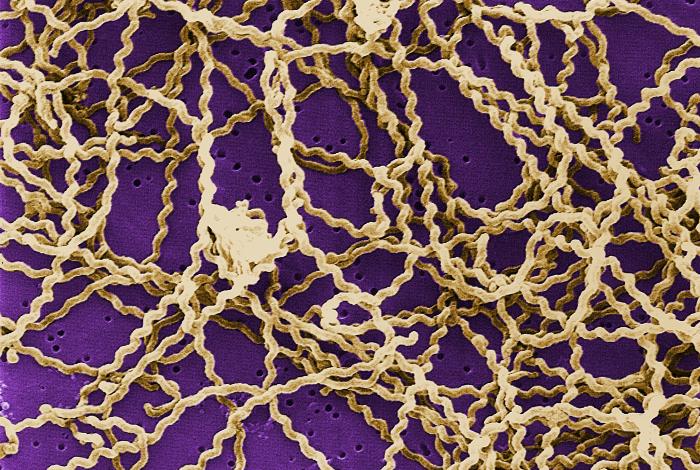
| Shape | Spirilla |
| Mobility | No |
| Flagellar presence | Yes |
| Number of membranes | 2 |

Image source: Wikipedia/Wikimedia
| Ecology, Host, and Life Cycle | |
|---|---|
| Oxygen requirements | Aerobe |
| Optimal temperature | 28 |
| Temperature range | Mesophilic |
| Habitat | HostAssociated |
| Biotic relationship | Not Available |
| Host(s) | Not Available |
| Cell arrangement | Not Available |
| Sporulation | Not Available |
| Energy source | Not Available |
| Pathogenicity | Not Available |
Gene Summary
Adenine Count
1437650 bp
Thymine Count
1426895 bp
Guanine Count
792604 bp
Cytosine Count
802357 bp
Genome Length
4459519 bp
Protein-coding Genes
6017 genes
Non-Coding Genes
66 genes
# of Chromosomes/Plasmids
1
Genes
| Name | Locus Tag | UniProt ID | Strand Orientation | Gene Start/End | Protein Molecular Weight |
|---|---|---|---|---|---|
| hypothetical protein | LEP1GSC170_6190 | Not Available | Negative | 3672279 - 3672578 | 10821.0 |
| hdig domain protein | LEP1GSC170_6191 | Not Available | Negative | 3672578 - 3673483 | 34120.8 |
| 7tm-hd extracellular | LEP1GSC170_6192 | Not Available | Negative | 3673471 - 3674691 | 46472.6 |
| phoh domain protein | LEP1GSC170_6193 | Not Available | Negative | 3674696 - 3675049 | 13427.5 |
| phoh domain protein | LEP1GSC170_6194 | Not Available | Negative | 3675087 - 3675257 | 5889.32 |
| penicillin-binding protein, transpeptidase domain protein | LEP1GSC170_2120 | Not Available | Positive | 3675264 - 3675804 | 19956.4 |
| hypothetical protein | LEP1GSC170_2121 | Not Available | Positive | 3675801 - 3676241 | 15688.0 |
| abc transporter, substrate-binding protein, family 5 | LEP1GSC170_2122 | Not Available | Negative | 3676219 - 3677154 | 35809.1 |
| hypothetical protein | LEP1GSC170_2123 | Not Available | Negative | 3677127 - 3677759 | 23605.8 |
| hypothetical protein | LEP1GSC170_2124 | Not Available | Positive | 3677828 - 3678073 | 9044.07 |
Pathways
0 pathways
No pathways found
No metabolic pathways have been associated with this bacterium yet.
Health Effects
No health effects information available for this bacterium.