Kingdom
Pseudomonadati
Phylum
Spirochaetota
Class
Leptospiria
Order
Leptospirales
Family
Leptospiraceae
Genus
Leptospira
Description
Taxonomy
| Kingdom | Pseudomonadati |
|---|---|
| Phylum | Spirochaetota |
| Class | Leptospiria |
| Order | Leptospirales |
| Family | Leptospiraceae |
| Genus | Leptospira |
| Species | Leptospira interrogans |
| Strain | serovar Bataviae HAI135 |
Profile
| Physiology | |
|---|---|
| Gram staining properties | Negative |
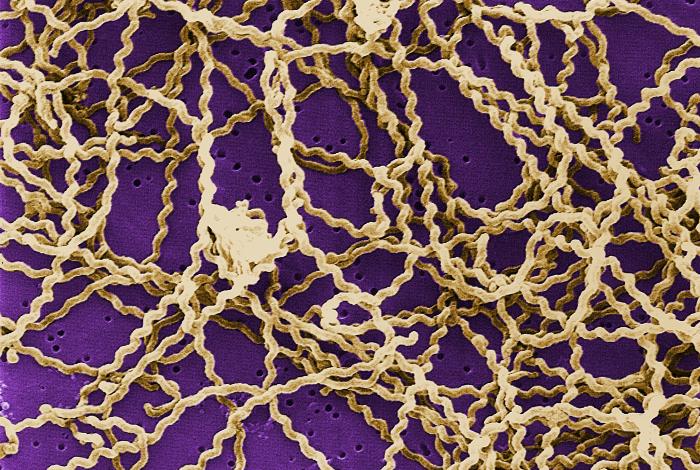
| Shape | Spirilla |
| Mobility | No |
| Flagellar presence | Yes |
| Number of membranes | 2 |

Image source: Wikipedia/Wikimedia
| Ecology, Host, and Life Cycle | |
|---|---|
| Oxygen requirements | Aerobe |
| Optimal temperature | 28 |
| Temperature range | Mesophilic |
| Habitat | HostAssociated |
| Biotic relationship | Not Available |
| Host(s) | Not Available |
| Cell arrangement | Not Available |
| Sporulation | Not Available |
| Energy source | Not Available |
| Pathogenicity | Not Available |
Gene Summary
Adenine Count
1437650 bp
Thymine Count
1426895 bp
Guanine Count
792604 bp
Cytosine Count
802357 bp
Genome Length
4459519 bp
Protein-coding Genes
6017 genes
Non-Coding Genes
66 genes
# of Chromosomes/Plasmids
1
Genes
| Name | Locus Tag | UniProt ID | Strand Orientation | Gene Start/End | Protein Molecular Weight |
|---|---|---|---|---|---|
| mase1 domain protein | LEP1GSC170_0470 | Not Available | Negative | 3443872 - 3444168 | 10935.8 |
| hypothetical protein | LEP1GSC170_0471 | Not Available | Positive | 3444422 - 3444790 | 14909.0 |
| chorismate binding enzyme domain protein | LEP1GSC170_0472 | Not Available | Positive | 3444802 - 3445061 | 9863.85 |
| hmgl-like protein | LEP1GSC170_3370 | Not Available | Positive | 3445078 - 3445953 | 31556.7 |
| tigr02757 family protein | LEP1GSC170_3371 | Not Available | Positive | 3445950 - 3446870 | 35873.1 |
| 3-demethylubiquinone-9 3-methyltransferase domain protein | LEP1GSC170_3372 | Not Available | Positive | 3447307 - 3447456 | 5922.89 |
| ribosomal protein l21 | LEP1GSC170_3374 | Not Available | Positive | 3448162 - 3448476 | 11896.4 |
| pf04327 family protein | LEP1GSC170_3375 | Not Available | Positive | 3448473 - 3448799 | 11926.4 |
| ribosomal protein l27 | LEP1GSC170_3376 | Not Available | Positive | 3448789 - 3449043 | 9103.15 |
| hypothetical protein | LEP1GSC170_3377 | Not Available | Negative | 3449031 - 3449153 | 4775.72 |
Pathways
0 pathways
No pathways found
No metabolic pathways have been associated with this bacterium yet.
Health Effects
No health effects information available for this bacterium.