Kingdom
Pseudomonadati
Phylum
Spirochaetota
Class
Leptospiria
Order
Leptospirales
Family
Leptospiraceae
Genus
Leptospira
Description
Taxonomy
| Kingdom | Pseudomonadati |
|---|---|
| Phylum | Spirochaetota |
| Class | Leptospiria |
| Order | Leptospirales |
| Family | Leptospiraceae |
| Genus | Leptospira |
| Species | Leptospira interrogans |
| Strain | serovar Bataviae HAI135 |
Profile
| Physiology | |
|---|---|
| Gram staining properties | Negative |
| Shape | Spirilla |
| Mobility | No |
| Flagellar presence | Yes |
| Number of membranes | 2 |

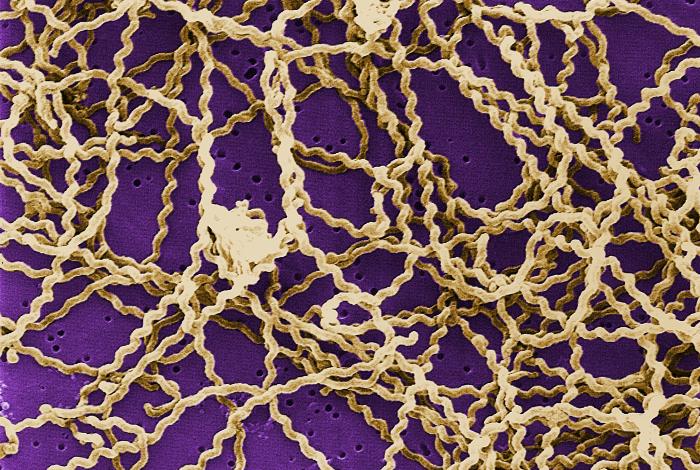
Image source: Wikipedia/Wikimedia
| Ecology, Host, and Life Cycle | |
|---|---|
| Oxygen requirements | Aerobe |
| Optimal temperature | 28 |
| Temperature range | Mesophilic |
| Habitat | HostAssociated |
| Biotic relationship | Not Available |
| Host(s) | Not Available |
| Cell arrangement | Not Available |
| Sporulation | Not Available |
| Energy source | Not Available |
| Pathogenicity | Not Available |
Gene Summary
Adenine Count
1437650 bp
Thymine Count
1426895 bp
Guanine Count
792604 bp
Cytosine Count
802357 bp
Genome Length
4459519 bp
Protein-coding Genes
6017 genes
Non-Coding Genes
66 genes
# of Chromosomes/Plasmids
1
Genes
| Name | Locus Tag | UniProt ID | Strand Orientation | Gene Start/End | Protein Molecular Weight |
|---|---|---|---|---|---|
| quinolinate synthetase complex, a subunit | LEP1GSC170_4870 | Not Available | Negative | 2044766 - 2045740 | 36448.0 |
| hypothetical protein | LEP1GSC170_4871 | Not Available | Negative | 2045919 - 2046320 | 15197.5 |
| hypothetical protein | LEP1GSC170_4872 | Not Available | Positive | 2046407 - 2047204 | 28664.1 |
| hypothetical protein | LEP1GSC170_4873 | Not Available | Positive | 2047495 - 2047845 | 13322.6 |
| cell division protein ftsz | LEP1GSC170_4874 | Not Available | Negative | 2048441 - 2049529 | 38860.0 |
| cell division protein ftsa | LEP1GSC170_4875 | Not Available | Negative | 2049548 - 2050777 | 43789.6 |
| potra domain protein, ftsq-type | LEP1GSC170_4876 | Not Available | Negative | 2050779 - 2051465 | 26239.9 |
| hypothetical protein | LEP1GSC170_4877 | Not Available | Positive | 2051738 - 2052538 | 30697.5 |
| hypothetical protein | LEP1GSC170_4878 | Not Available | Positive | 2052597 - 2053058 | 16784.0 |
| undecaprenol kinase domain protein | LEP1GSC170_0151 | Not Available | Positive | 2053129 - 2053581 | 17122.8 |
Pathways
0 pathways
No pathways found
No metabolic pathways have been associated with this bacterium yet.
Health Effects
No health effects information available for this bacterium.