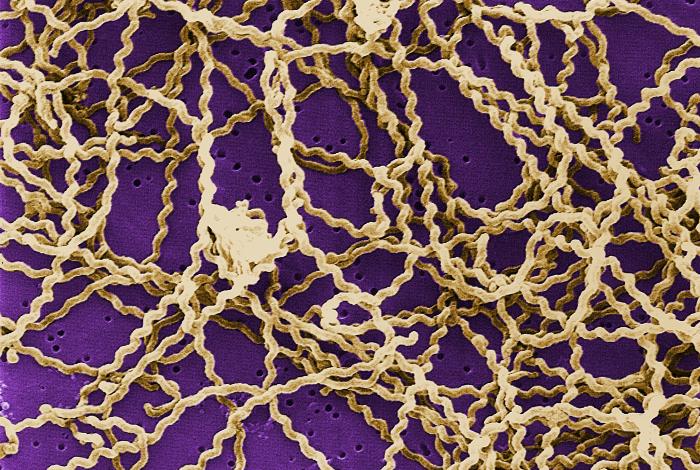
Kingdom
Pseudomonadati
Phylum
Spirochaetota
Class
Leptospiria
Order
Leptospirales
Family
Leptospiraceae
Genus
Leptospira
Description
Taxonomy
| Kingdom | Pseudomonadati |
|---|---|
| Phylum | Spirochaetota |
| Class | Leptospiria |
| Order | Leptospirales |
| Family | Leptospiraceae |
| Genus | Leptospira |
| Species | Leptospira interrogans |
| Strain | serovar Bataviae HAI135 |
Profile
| Physiology | |
|---|---|
| Gram staining properties | Negative |
| Shape | Spirilla |
| Mobility | No |
| Flagellar presence | Yes |
| Number of membranes | 2 |

Image source: Wikipedia/Wikimedia
| Ecology, Host, and Life Cycle | |
|---|---|
| Oxygen requirements | Aerobe |
| Optimal temperature | 28 |
| Temperature range | Mesophilic |
| Habitat | HostAssociated |
| Biotic relationship | Not Available |
| Host(s) | Not Available |
| Cell arrangement | Not Available |
| Sporulation | Not Available |
| Energy source | Not Available |
| Pathogenicity | Not Available |
Gene Summary
Adenine Count
1437650 bp
Thymine Count
1426895 bp
Guanine Count
792604 bp
Cytosine Count
802357 bp
Genome Length
4459519 bp
Protein-coding Genes
6017 genes
Non-Coding Genes
66 genes
# of Chromosomes/Plasmids
1
Genes
| Name | Locus Tag | UniProt ID | Strand Orientation | Gene Start/End | Protein Molecular Weight |
|---|---|---|---|---|---|
| proton-translocating nadh-quinone oxidoreductase, chain n | LEP1GSC170_3409 | Not Available | Negative | 1669949 - 1671325 | 50467.9 |
| proton-translocating nadh-quinone oxidoreductase, chain m | LEP1GSC170_3410 | Not Available | Negative | 1671322 - 1672563 | 45931.3 |
| hypothetical protein | LEP1GSC170_3411 | Not Available | Negative | 1672701 - 1672958 | 9793.12 |
| proton-translocating nadh-quinone oxidoreductase, chain l | LEP1GSC170_3412 | Not Available | Negative | 1673018 - 1674952 | 70648.0 |
| nadh-ubiquinone/plastoquinone oxidoreductase chain 4l | LEP1GSC170_3413 | Not Available | Negative | 1674957 - 1675277 | 11755.0 |
| nadh-ubiquinone/plastoquinone oxidoreductase chain 6 | LEP1GSC170_3414 | Not Available | Negative | 1675274 - 1675819 | 19866.5 |
| hypothetical protein | LEP1GSC170_3415 | Not Available | Negative | 1675819 - 1675974 | 5818.31 |
| nadh dehydrogenase | LEP1GSC170_3416 | Not Available | Negative | 1675980 - 1677026 | 38814.3 |
| nadh oxidoreductase (quinone), f subunit | LEP1GSC170_3417 | Not Available | Negative | 1677023 - 1678351 | 48614.6 |
| nadh-quinone oxidoreductase, e subunit | LEP1GSC170_3418 | Not Available | Negative | 1678367 - 1678852 | 18397.1 |
Pathways
0 pathways
No pathways found
No metabolic pathways have been associated with this bacterium yet.
Health Effects
No health effects information available for this bacterium.