Kingdom
Pseudomonadati
Phylum
Spirochaetota
Class
Leptospiria
Order
Leptospirales
Family
Leptospiraceae
Genus
Leptospira
Description
Taxonomy
| Kingdom | Pseudomonadati |
|---|---|
| Phylum | Spirochaetota |
| Class | Leptospiria |
| Order | Leptospirales |
| Family | Leptospiraceae |
| Genus | Leptospira |
| Species | Leptospira interrogans |
| Strain | serovar Bataviae HAI135 |
Profile
| Physiology | |
|---|---|
| Gram staining properties | Negative |
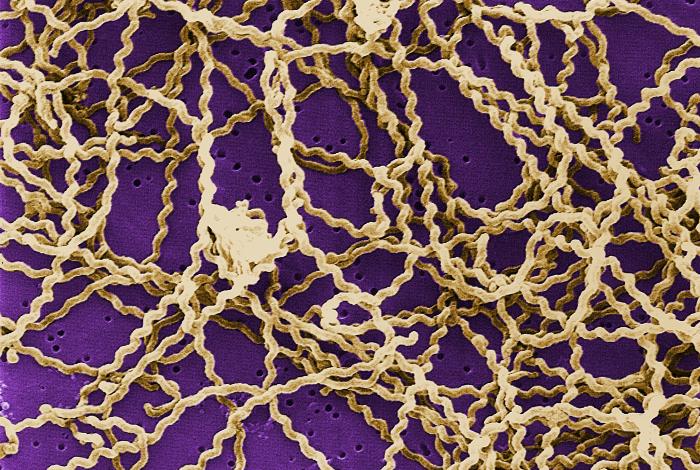
| Shape | Spirilla |
| Mobility | No |
| Flagellar presence | Yes |
| Number of membranes | 2 |

Image source: Wikipedia/Wikimedia
| Ecology, Host, and Life Cycle | |
|---|---|
| Oxygen requirements | Aerobe |
| Optimal temperature | 28 |
| Temperature range | Mesophilic |
| Habitat | HostAssociated |
| Biotic relationship | Not Available |
| Host(s) | Not Available |
| Cell arrangement | Not Available |
| Sporulation | Not Available |
| Energy source | Not Available |
| Pathogenicity | Not Available |
Gene Summary
Adenine Count
1437650 bp
Thymine Count
1426895 bp
Guanine Count
792604 bp
Cytosine Count
802357 bp
Genome Length
4459519 bp
Protein-coding Genes
6017 genes
Non-Coding Genes
66 genes
# of Chromosomes/Plasmids
1
Genes
| Name | Locus Tag | UniProt ID | Strand Orientation | Gene Start/End | Protein Molecular Weight |
|---|---|---|---|---|---|
| hypothetical protein | LEP1GSC170_0972 | Not Available | Positive | 1647040 - 1647465 | 16052.4 |
| transporter, mota/tolq/exbb proton channel domain protein | LEP1GSC170_0973 | Not Available | Positive | 1647431 - 1647640 | 7590.47 |
| hypothetical protein | LEP1GSC170_0443 | Not Available | Negative | 1647794 - 1647958 | 6501.1 |
| hypothetical protein | LEP1GSC170_0444 | Not Available | Positive | 1647991 - 1648143 | 5866.06 |
| hypothetical protein | LEP1GSC170_0445 | Not Available | Negative | 1648195 - 1648419 | 8683.74 |
| hypothetical protein | LEP1GSC170_0446 | Not Available | Positive | 1648857 - 1648970 | 4615.83 |
| queuosine biosynthesis protein qued | LEP1GSC170_5123 | Not Available | Negative | 1648996 - 1649367 | 14340.4 |
| hypothetical protein | LEP1GSC170_5124 | Not Available | Negative | 1649503 - 1649649 | 5792.18 |
| penicillin amidase | LEP1GSC170_5125 | Not Available | Positive | 1650298 - 1652022 | 65032.5 |
| penicillin amidase domain protein | LEP1GSC170_5126 | Not Available | Positive | 1652010 - 1652813 | 30576.3 |
Pathways
0 pathways
No pathways found
No metabolic pathways have been associated with this bacterium yet.
Health Effects
No health effects information available for this bacterium.