Kingdom
Pseudomonadati
Phylum
Spirochaetota
Class
Leptospiria
Order
Leptospirales
Family
Leptospiraceae
Genus
Leptospira
Description
Taxonomy
| Kingdom | Pseudomonadati |
|---|---|
| Phylum | Spirochaetota |
| Class | Leptospiria |
| Order | Leptospirales |
| Family | Leptospiraceae |
| Genus | Leptospira |
| Species | Leptospira interrogans |
| Strain | serovar Bataviae HAI135 |
Profile
| Physiology | |
|---|---|
| Gram staining properties | Negative |
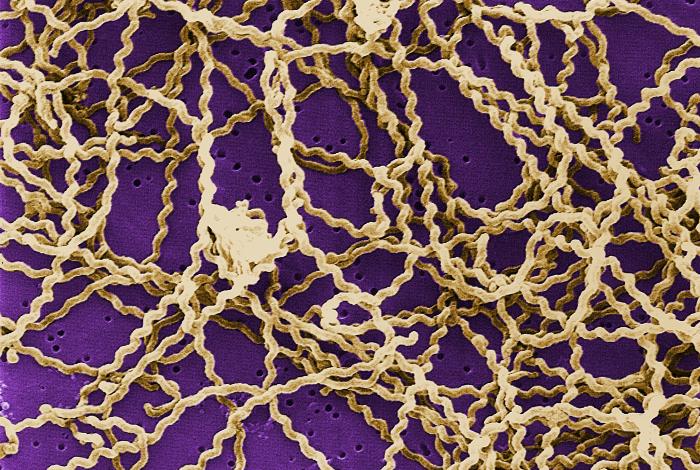
| Shape | Spirilla |
| Mobility | No |
| Flagellar presence | Yes |
| Number of membranes | 2 |

Image source: Wikipedia/Wikimedia
| Ecology, Host, and Life Cycle | |
|---|---|
| Oxygen requirements | Aerobe |
| Optimal temperature | 28 |
| Temperature range | Mesophilic |
| Habitat | HostAssociated |
| Biotic relationship | Not Available |
| Host(s) | Not Available |
| Cell arrangement | Not Available |
| Sporulation | Not Available |
| Energy source | Not Available |
| Pathogenicity | Not Available |
Gene Summary
Adenine Count
1437650 bp
Thymine Count
1426895 bp
Guanine Count
792604 bp
Cytosine Count
802357 bp
Genome Length
4459519 bp
Protein-coding Genes
6017 genes
Non-Coding Genes
66 genes
# of Chromosomes/Plasmids
1
Genes
| Name | Locus Tag | UniProt ID | Strand Orientation | Gene Start/End | Protein Molecular Weight |
|---|---|---|---|---|---|
| threonine--trna ligase-like protein | LEP1GSC170_6092 | Not Available | Positive | 1475418 - 1476377 | 37119.3 |
| hypothetical protein | LEP1GSC170_4589 | Not Available | Negative | 1477142 - 1477779 | 24225.1 |
| cytochrome c oxidase, cbb3-type, subunit i | LEP1GSC170_1288 | Not Available | Positive | 1477905 - 1479341 | 54672.5 |
| cytochrome c oxidase, mono-heme subunit/fixo | LEP1GSC170_1289 | Not Available | Positive | 1479338 - 1480027 | 26034.2 |
| hypothetical protein | LEP1GSC170_1290 | Not Available | Positive | 1480036 - 1480182 | 5828.39 |
| cytochrome c | LEP1GSC170_1291 | Not Available | Positive | 1480187 - 1480720 | 20108.9 |
| hypothetical protein | LEP1GSC170_1292 | Not Available | Positive | 1480727 - 1480969 | 9568.14 |
| hypothetical protein | LEP1GSC170_1293 | Not Available | Positive | 1481008 - 1481331 | 12467.3 |
| ubp3 associated protein bre5 | LEP1GSC170_1294 | Not Available | Positive | 1481331 - 1482047 | 26604.5 |
| fixh family protein | LEP1GSC170_1295 | Not Available | Positive | 1482076 - 1482552 | 18101.0 |
Pathways
0 pathways
No pathways found
No metabolic pathways have been associated with this bacterium yet.
Health Effects
No health effects information available for this bacterium.