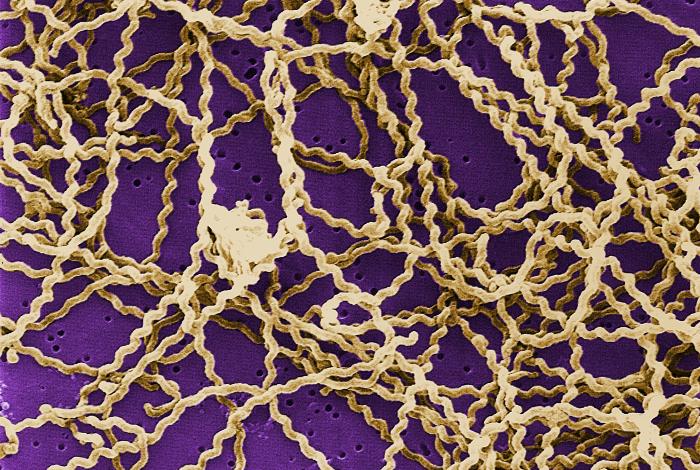
Kingdom
Pseudomonadati
Phylum
Spirochaetota
Class
Leptospiria
Order
Leptospirales
Family
Leptospiraceae
Genus
Leptospira
Description
Taxonomy
| Kingdom | Pseudomonadati |
|---|---|
| Phylum | Spirochaetota |
| Class | Leptospiria |
| Order | Leptospirales |
| Family | Leptospiraceae |
| Genus | Leptospira |
| Species | Leptospira interrogans |
| Strain | serovar Copenhageni LT2050 |
Profile
| Physiology | |
|---|---|
| Gram staining properties | Negative |
| Shape | Spirilla |
| Mobility | No |
| Flagellar presence | Yes |
| Number of membranes | 2 |

Image source: Wikipedia/Wikimedia
| Ecology, Host, and Life Cycle | |
|---|---|
| Oxygen requirements | Aerobe |
| Optimal temperature | 28 |
| Temperature range | Mesophilic |
| Habitat | HostAssociated |
| Biotic relationship | Not Available |
| Host(s) | Not Available |
| Cell arrangement | Not Available |
| Sporulation | Not Available |
| Energy source | Not Available |
| Pathogenicity | Not Available |
Gene Summary
Adenine Count
1441319 bp
Thymine Count
1452765 bp
Guanine Count
798782 bp
Cytosine Count
771780 bp
Genome Length
4464661 bp
Protein-coding Genes
5396 genes
Non-Coding Genes
44 genes
# of Chromosomes/Plasmids
1
Genes
| Name | Locus Tag | UniProt ID | Strand Orientation | Gene Start/End | Protein Molecular Weight |
|---|---|---|---|---|---|
| stearoyl-coa 9-desaturase | LEP1GSC150_1821 | Not Available | Negative | 528879 - 529823 | 37404.7 |
| pf10825 family protein | LEP1GSC150_1822 | Not Available | Negative | 530329 - 530637 | 12405.6 |
| hypothetical protein | LEP1GSC150_1823 | Not Available | Negative | 530886 - 531017 | 4723.78 |
| hypothetical protein | LEP1GSC150_1824 | Not Available | Positive | 531657 - 532175 | 19757.5 |
| hypothetical protein | LEP1GSC150_1825 | Not Available | Positive | 532129 - 532260 | 5396.74 |
| hypothetical protein | LEP1GSC150_1826 | Not Available | Positive | 532588 - 532758 | 6898.39 |
| beta-lactamase family protein | LEP1GSC150_1827 | Not Available | Positive | 532854 - 533630 | 29379.6 |
| glycosyltransferase family 1 | LEP1GSC150_1828 | Not Available | Negative | 533849 - 534973 | 42898.6 |
| rna methyltransferase, trmh family | LEP1GSC150_1829 | Not Available | Negative | 534970 - 535425 | 16634.2 |
| hypothetical protein | LEP1GSC150_1830 | Not Available | Negative | 535670 - 535792 | 4840.83 |
Pathways
0 pathways
No pathways found
No metabolic pathways have been associated with this bacterium yet.
Health Effects
No health effects information available for this bacterium.