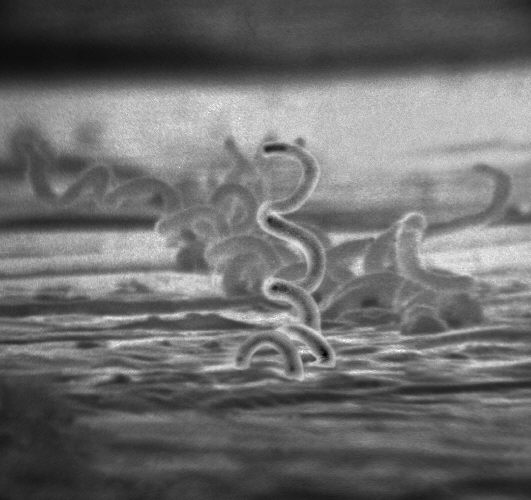
Kingdom
Pseudomonadati
Phylum
Spirochaetota
Class
Spirochaetia
Order
Spirochaetales
Family
Treponemataceae
Genus
Treponema
Description
Taxonomy
| Kingdom | Pseudomonadati |
|---|---|
| Phylum | Spirochaetota |
| Class | Spirochaetia |
| Order | Spirochaetales |
| Family | Treponemataceae |
| Genus | Treponema |
| Species | Treponema denticola |
| Strain | H1-T |
Profile
| Physiology | |
|---|---|
| Gram staining properties | Negative |
| Shape | Spirilla |
| Mobility | No |
| Flagellar presence | Yes |
| Number of membranes | 2 |
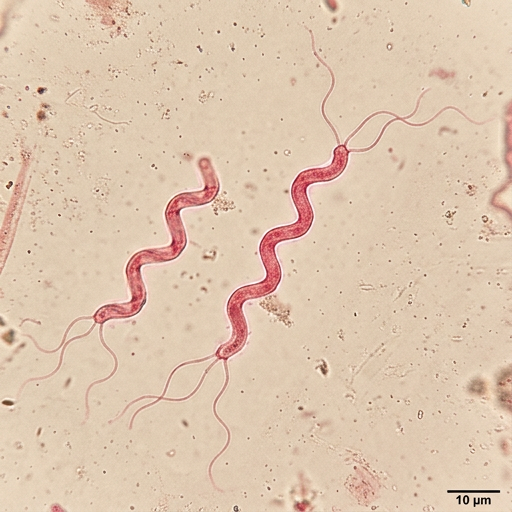
AI-generated image based on bacteria physiology
| Ecology, Host, and Life Cycle | |
|---|---|
| Oxygen requirements | Anaerobe |
| Optimal temperature | 30 |
| Temperature range | Mesophilic |
| Habitat | HostAssociated |
| Biotic relationship | Free living |
| Host(s) | Not Available |
| Cell arrangement | Singles |
| Sporulation | Not Available |
| Energy source | Not Available |
| Pathogenicity | Not Available |
Genome Summary
Treponema denticola H1-T cont1.26, whole genome shotgun sequence.
Gene Summary
Adenine Count
906504 bp
Thymine Count
906132 bp
Guanine Count
556668 bp
Cytosine Count
551295 bp
Genome Length
2920599 bp
Protein-coding Genes
2675 genes
Non-Coding Genes
83 genes
# of Chromosomes/Plasmids
2
Genes
| Name | Locus Tag | UniProt ID | Strand Orientation | Gene Start/End | Protein Molecular Weight |
|---|---|---|---|---|---|
| type ii toxin-antitoxin system rele family toxin | HMPREF9725_RS07655 | Not Available | Positive | 1687783 - 1688040 | 9991.35 |
| brnt family toxin | HMPREF9725_RS07660 | Not Available | Positive | 1688258 - 1688539 | 11267.4 |
| brna antitoxin family protein | HMPREF9725_RS07665 | Not Available | Positive | 1688508 - 1688861 | 13395.7 |
| had family hydrolase | HMPREF9725_RS07670 | Not Available | Negative | 1689010 - 1690176 | 44090.7 |
| rpn family recombination-promoting nuclease/putative transposase | HMPREF9725_RS07675 | Not Available | Negative | 1690300 - 1691163 | 33679.3 |
| undecaprenyldiphospho-muramoylpentapeptide beta-n-acetylglucosaminyltransferase | HMPREF9725_RS07680 | Not Available | Positive | 1691418 - 1692593 | 42630.9 |
| cvpa family protein | HMPREF9725_RS07685 | Not Available | Positive | 1692622 - 1693089 | 17024.7 |
| hypothetical protein | HMPREF9725_RS07690 | Not Available | Positive | 1693104 - 1694393 | 48485.9 |
| two-component system sensor histidine kinase ntrb | HMPREF9725_RS07695 | Not Available | Positive | 1694390 - 1695637 | 46419.0 |
| sigma-54-dependent transcriptional regulator | HMPREF9725_RS07700 | Not Available | Positive | 1695634 - 1697055 | 53084.1 |
Pathways
0 pathways
No pathways found
No metabolic pathways have been associated with this bacterium yet.
Health Effects
No health effects information available for this bacterium.