
Kingdom
Pseudomonadati
Phylum
Pseudomonadota
Class
Gammaproteobacteria
Order
Enterobacterales
Family
Enterobacteriaceae
Genus
Salmonella
Description
Taxonomy
| Kingdom | Pseudomonadati |
|---|---|
| Phylum | Pseudomonadota |
| Class | Gammaproteobacteria |
| Order | Enterobacterales |
| Family | Enterobacteriaceae |
| Genus | Salmonella |
| Species | Salmonella enterica |
| Strain | subsp. enterica serovar Wandsworth A4-580 |
Profile
| Physiology | |
|---|---|
| Gram staining properties | Negative |
| Shape | Spirilla |
| Mobility | No |
| Flagellar presence | Yes |
| Number of membranes | 2 |
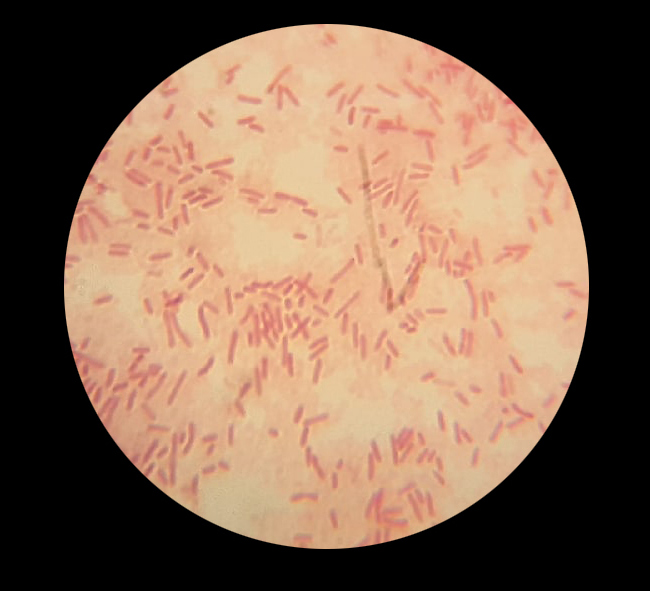
Image source: Wikipedia/Wikimedia
| Ecology, Host, and Life Cycle | |
|---|---|
| Oxygen requirements | Microaerophilic |
| Optimal temperature | 37 |
| Temperature range | Mesophilic |
| Habitat | HostAssociated |
| Biotic relationship | Free living |
| Host(s) | Not Available |
| Cell arrangement | Chains - Singles |
| Sporulation | Not Available |
| Energy source | Chemoorganotroph |
| Pathogenicity | Not Available |
Gene Summary
Adenine Count
1140911 bp
Thymine Count
1140855 bp
Guanine Count
1246251 bp
Cytosine Count
1245914 bp
Genome Length
4774189 bp
Protein-coding Genes
5278 genes
Non-Coding Genes
128 genes
# of Chromosomes/Plasmids
1
Genes
| Name | Locus Tag | UniProt ID | Strand Orientation | Gene Start/End | Protein Molecular Weight |
|---|---|---|---|---|---|
| cobalamin adenosyltransferase pduo | LTSEWAN_3419 | Not Available | Positive | 2411148 - 2412158 | 36642.6 |
| putative coa-dependent proprionaldehyde dehydrogenase | LTSEWAN_3420 | Not Available | Positive | 2412155 - 2413549 | 49048.4 |
| putative propanol dehydrogenase | LTSEWAN_3421 | Not Available | Positive | 2413561 - 2414673 | 39463.7 |
| cob 2-alamin reductase | LTSEWAN_3422 | Not Available | Positive | 2414670 - 2416025 | 48395.4 |
| propanediol utilization polyhedral body protein pdut | LTSEWAN_3423 | Not Available | Positive | 2416028 - 2416582 | 19151.5 |
| propanediol utilization polyhedral body protein pduu | LTSEWAN_3424 | Not Available | Positive | 2416609 - 2416932 | 11361.9 |
| propanediol utilization protein pduv | LTSEWAN_3425 | Not Available | Positive | 2416937 - 2417360 | 15437.7 |
| hypothetical protein | LTSEWAN_3426 | Not Available | Positive | 2417361 - 2417466 | 3609.3 |
| propionate kinase | LTSEWAN_3427 | Not Available | Positive | 2417501 - 2418700 | 43391.2 |
| threonine kinase in b12 biosynthesis | LTSEWAN_3428 | Not Available | Positive | 2418794 - 2419660 | 31424.1 |
Pathways
0 pathways
No pathways found
No metabolic pathways have been associated with this bacterium yet.
Health Effects
No health effects information available for this bacterium.


