
Kingdom
Pseudomonadati
Phylum
Pseudomonadota
Class
Gammaproteobacteria
Order
Enterobacterales
Family
Enterobacteriaceae
Genus
Salmonella
Description
Taxonomy
| Kingdom | Pseudomonadati |
|---|---|
| Phylum | Pseudomonadota |
| Class | Gammaproteobacteria |
| Order | Enterobacterales |
| Family | Enterobacteriaceae |
| Genus | Salmonella |
| Species | Salmonella enterica |
| Strain | subsp. enterica serovar Wandsworth A4-580 |
Profile
| Physiology | |
|---|---|
| Gram staining properties | Negative |
| Shape | Spirilla |
| Mobility | No |
| Flagellar presence | Yes |
| Number of membranes | 2 |
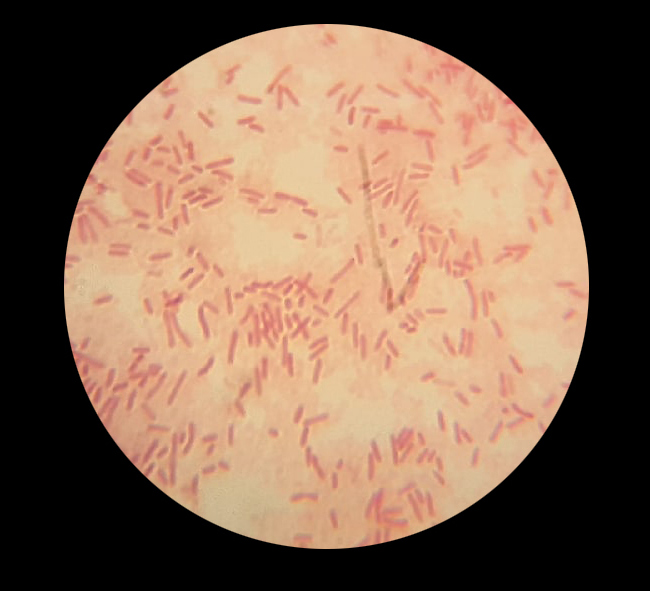
Image source: Wikipedia/Wikimedia
| Ecology, Host, and Life Cycle | |
|---|---|
| Oxygen requirements | Microaerophilic |
| Optimal temperature | 37 |
| Temperature range | Mesophilic |
| Habitat | HostAssociated |
| Biotic relationship | Free living |
| Host(s) | Not Available |
| Cell arrangement | Chains - Singles |
| Sporulation | Not Available |
| Energy source | Chemoorganotroph |
| Pathogenicity | Not Available |
Gene Summary
Adenine Count
1140911 bp
Thymine Count
1140855 bp
Guanine Count
1246251 bp
Cytosine Count
1245914 bp
Genome Length
4774189 bp
Protein-coding Genes
5278 genes
Non-Coding Genes
128 genes
# of Chromosomes/Plasmids
1
Genes
| Name | Locus Tag | UniProt ID | Strand Orientation | Gene Start/End | Protein Molecular Weight |
|---|---|---|---|---|---|
| flagellar basal-body rod protein flgc | LTSEWAN_3254 | Not Available | Negative | 2297441 - 2297845 | 13982.8 |
| flagellar basal-body rod protein flgb | LTSEWAN_3255 | Not Available | Negative | 2297849 - 2298265 | 15111.0 |
| flagellar basal-body p-ring formation protein flga | LTSEWAN_3256 | Not Available | Positive | 2298422 - 2298737 | 11320.7 |
| flagellar basal-body p-ring formation protein flga | LTSEWAN_3257 | Not Available | Positive | 2298743 - 2299008 | 9670.72 |
| hypothetical protein | LTSEWAN_3258 | Not Available | Positive | 2299052 - 2299186 | 5115.48 |
| negative regulator of flagellin synthesis flgm | LTSEWAN_3259 | Not Available | Positive | 2299187 - 2299480 | 10568.6 |
| flagellar biosynthesis protein flgn | LTSEWAN_3260 | Not Available | Positive | 2299485 - 2299907 | 15989.8 |
| proposed peptidoglycan lipid ii flippase murj | LTSEWAN_3261 | Not Available | Negative | 2299989 - 2301563 | 57318.2 |
| hypothetical protein | LTSEWAN_3262 | Not Available | Positive | 2301530 - 2301706 | 6439.78 |
| virulence factor mvim | LTSEWAN_3263 | Not Available | Negative | 2301828 - 2302107 | 10327.1 |
Pathways
0 pathways
No pathways found
No metabolic pathways have been associated with this bacterium yet.
Health Effects
No health effects information available for this bacterium.


