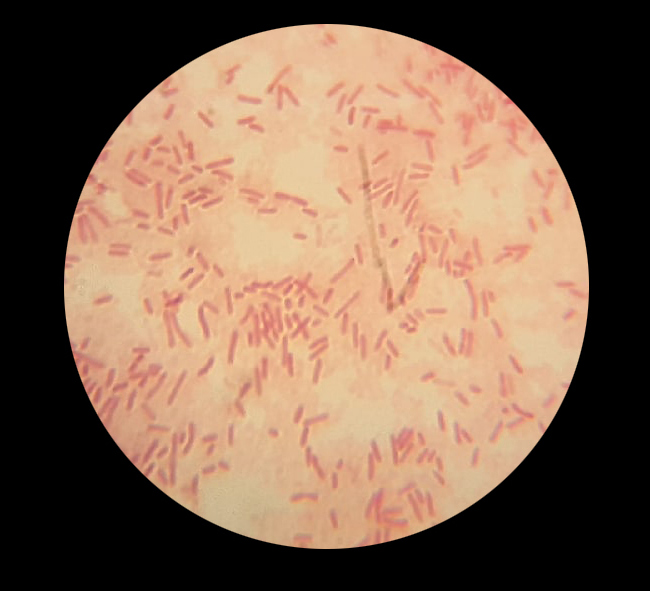
Salmonella enterica subsp. enterica serovar Johannesburg

Gram-negativeSpirillaNon-motileMicroaerophilic

Kingdom

Pseudomonadati

Phylum

Pseudomonadota

Class

Gammaproteobacteria

Order

Enterobacterales

Family

Enterobacteriaceae

Genus

Salmonella

Description

Salmonella enterica subsp. enterica serovar Johannesburg is a Gram-negative, microaerophilic bacterium characterized by its spirilla shape and tendency to form chains or exist as singles. This organism thrives at an optimal temperature of 37°C, which coincides with the typical body temperature of its warm-blooded hosts. As a chemoorganotroph, S. enterica serovar Johannesburg derives its energy from organic compounds, reflecting its adaptation to a host-associated habitat where it may utilize various substrates derived from host metabolism. The microaerophilic nature of this serovar suggests that it thrives in environments with reduced oxygen levels, which is consistent with its potential colonization in the gastrointestinal tracts of animals and humans. The chain arrangement of the cells may facilitate specific interactions within these host environments, potentially influencing its ecological dynamics and interactions with the host microbiome. Understanding the ecological niche and metabolic capabilities of S. enterica serovar Johannesburg can provide insights into its role in microbial communities associated with gastrointestinal habitats. The ability to adapt to microaerophilic conditions may also shed light on its resilience and survival strategies in fluctuating environments within the host, highlighting the intricate relationships between pathogens and their hosts in various ecological contexts.

Taxonomy

KingdomPseudomonadati
PhylumPseudomonadota
ClassGammaproteobacteria
OrderEnterobacterales
FamilyEnterobacteriaceae
GenusSalmonella
SpeciesSalmonella enterica
Strainsubsp. enterica serovar Johannesburg

Profile

Physiology
Gram staining propertiesNegative
ShapeSpirilla
MobilityNo
Flagellar presenceYes
Number of membranes2
Image of Salmonella enterica subsp. enterica serovar Johannesburg
Image source: Wikipedia/Wikimedia
Ecology, Host, and Life Cycle
Oxygen requirementsMicroaerophilic
Optimal temperature37
Temperature rangeMesophilic
HabitatHostAssociated
Biotic relationshipFree living
Host(s)Not Available
Cell arrangementChains - Singles
SporulationNot Available
Energy sourceChemoorganotroph
PathogenicityNot Available

Genome Summary

Salmonella enterica subsp. enterica serovar Johannesburg strain

Gene Summary

Adenine Count

1081352 bp

Thymine Count

1089081 bp

Guanine Count

1217922 bp

Cytosine Count

1156199 bp

Genome Length

4544554 bp

Protein-coding Genes

4120 genes

Non-Coding Genes

245 genes

# of Chromosomes/Plasmids

1

Genes

NameLocus TagUniProt IDStrand OrientationGene Start/EndProtein Molecular Weight
sulfur relay protein tusdAEX30_10195B5F8G3Positive2115977 - 211636313707.2
sulfur relay protein tuscAEX30_10200B5F8G2Positive2116363 - 211671913001.6
sulfur relay protein tusbAEX30_10205B5F8G1Positive2116727 - 211701410502.7
30s ribosomal protein s12AEX30_10210A7ZSL7Positive2117140 - 211751413737.9
30s ribosomal protein s7AEX30_10215A7ZSL6Positive2117610 - 211808017605.4
elongation factor gAEX30_10220B5F8F8Positive2118177 - 212029177603.7
cytoplasmic proteinAEX30_10230Not AvailablePositive2120807 - 212126217918.2
alpha-ketoglutarate transporterAEX30_10235P0AEX3Positive2121366 - 212266747296.8
hypothetical proteinAEX30_10240P46126Negative2122664 - 212298711809.0
phosphatidylserine synthaseAEX30_10245P23830Negative2123032 - 212438752736.7

Displaying genes 2131 – 2140 of 4365 in total

Pathways

0 pathways

No pathways found

No metabolic pathways have been associated with this bacterium yet.

Metabolites

310 records
Metabolite IDMetabolite nameStructureCAS number
BASm0000217alpha-ribazoleC14H18N2O4Chemical structure of alpha-ribazoleNot available
Average278.3037Da
Monoisotopic278.126657074Da
BASm0000237(R)-4'-phosphopantothenateC9H18NO8PChemical structure of (R)-4'-phosphopantothenateNot available
Average299.2149Da
Monoisotopic299.0770031Da
BASm00002502,5-didehydro-D-gluconateC6H7O7Chemical structure of 2,5-didehydro-D-gluconate53736-12-2
Average191.1156Da
Monoisotopic191.019177578Da
BASm00002512-dehydropantoateC6H9O4Chemical structure of 2-dehydropantoateNot available
Average145.1333Da
Monoisotopic145.050083776Da
BASm0000274aldehydo-D-galacturonateC6H9O7Chemical structure of aldehydo-D-galacturonateNot available
Average193.132Da
Monoisotopic193.0353762Da
BASm0000377(S)-malateC4H4O5Chemical structure of (S)-malateNot available
Average132.0716Da
Monoisotopic132.005873238Da
BASm0000387(6R)-5,10-methylene-5,6,7,8-tetrahydrofolateC20H21N7O6Chemical structure of (6R)-5,10-methylene-5,6,7,8-tetrahydrofolateNot available
Average455.432Da
Monoisotopic455.1564286Da
BASm0000401(S)-2-succinylamino-6-oxoheptanedioateC11H12NO8Chemical structure of (S)-2-succinylamino-6-oxoheptanedioateNot available
Average286.218Da
Monoisotopic286.0579371Da
BASm00005275-oxopentanoateC5H7O3Chemical structure of 5-oxopentanoateNot available
Average115.109Da
Monoisotopic115.040067665Da
BASm0000642S-adenosyl-4-methylsulfanyl-2-oxobutanoateC15H19N5O6SChemical structure of S-adenosyl-4-methylsulfanyl-2-oxobutanoateNot available
Average397.406Da
Monoisotopic397.105604055Da

Displaying 1–10 of 310 metabolites

Health Effects

No health effects information available for this bacterium.