Kingdom
Pseudomonadati
Phylum
Pseudomonadota
Class
Gammaproteobacteria
Order
Enterobacterales
Family
Enterobacteriaceae
Genus
Shigella
Description
Taxonomy
| Kingdom | Pseudomonadati |
|---|---|
| Phylum | Pseudomonadota |
| Class | Gammaproteobacteria |
| Order | Enterobacterales |
| Family | Enterobacteriaceae |
| Genus | Shigella |
| Species | Shigella dysenteriae |
| Strain | 1617 |
Profile
| Physiology | |
|---|---|
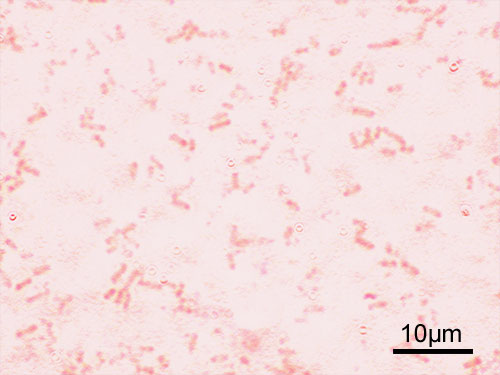
| Gram staining properties | Negative |
| Shape | Rod |
| Mobility | No |
| Flagellar presence | Yes |
| Number of membranes | 2 |

Image source: Wikipedia/Wikimedia
| Ecology, Host, and Life Cycle | |
|---|---|
| Oxygen requirements | Facultative anaerobe |
| Optimal temperature | 37 |
| Temperature range | Mesophilic |
| Habitat | HostAssociated |
| Biotic relationship | Free living |
| Host(s) | Not Available |
| Cell arrangement | Pairs - Singles |
| Sporulation | Not Available |
| Energy source | Chemoorganotroph |
| Pathogenicity | Not Available |
Gene Summary
Adenine Count
1128216 bp
Thymine Count
1123711 bp
Guanine Count
1187326 bp
Cytosine Count
1174304 bp
Genome Length
4613557 bp
Protein-coding Genes
5602 genes
Non-Coding Genes
396 genes
# of Chromosomes/Plasmids
2
Genes
| Name | Locus Tag | UniProt ID | Strand Orientation | Gene Start/End | Protein Molecular Weight |
|---|---|---|---|---|---|
| class ii aldolase, tagatose bisphosphate family | SD1617_4453 | Not Available | Negative | 3573460 - 3574314 | 30885.8 |
| fructose-bisphosphate aldolase class 1 | SD1617_4454 | Not Available | Negative | 3574544 - 3575596 | 38111.4 |
| putative nucleoside transporter yegt | SD1617_4455 | Not Available | Positive | 3575880 - 3577130 | 46399.6 |
| adp-ribosylglycohydrolase family protein | SD1617_4456 | Not Available | Positive | 3577127 - 3578131 | 35591.5 |
| uncharacterized sugar kinase yegv | SD1617_4457 | Not Available | Positive | 3578128 - 3579093 | 34394.5 |
| transcriptional regulator, gntr family protein | SD1617_4458 | Not Available | Negative | 3579067 - 3579813 | 28278.8 |
| glycosyl hydrolases family 25 family protein | SD1617_4459 | Not Available | Negative | 3579865 - 3580362 | 19188.5 |
| uncharacterized yegx domain protein | SD1617_4460 | Not Available | Negative | 3580375 - 3580629 | 9962.12 |
| phosphomethylpyrimidine kinase | SD1617_4461 | Not Available | Negative | 3580748 - 3581548 | 28665.3 |
| hydroxyethylthiazole kinase | SD1617_4462 | Not Available | Negative | 3581545 - 3582252 | 24402.2 |
Pathways
0 pathways
No pathways found
No metabolic pathways have been associated with this bacterium yet.
Health Effects
No health effects information available for this bacterium.