Kingdom
Pseudomonadati
Phylum
Pseudomonadota
Class
Gammaproteobacteria
Order
Enterobacterales
Family
Enterobacteriaceae
Genus
Shigella
Description
Taxonomy
| Kingdom | Pseudomonadati |
|---|---|
| Phylum | Pseudomonadota |
| Class | Gammaproteobacteria |
| Order | Enterobacterales |
| Family | Enterobacteriaceae |
| Genus | Shigella |
| Species | Shigella dysenteriae |
| Strain | 1617 |
Profile
| Physiology | |
|---|---|
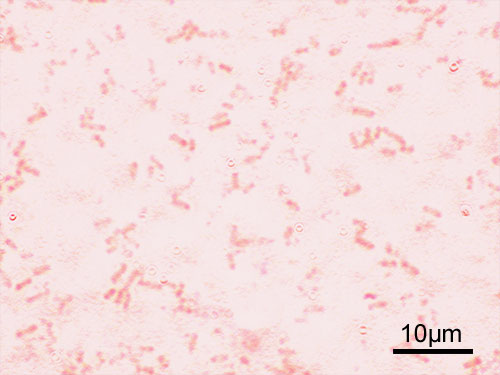
| Gram staining properties | Negative |
| Shape | Rod |
| Mobility | No |
| Flagellar presence | Yes |
| Number of membranes | 2 |

Image source: Wikipedia/Wikimedia
| Ecology, Host, and Life Cycle | |
|---|---|
| Oxygen requirements | Facultative anaerobe |
| Optimal temperature | 37 |
| Temperature range | Mesophilic |
| Habitat | HostAssociated |
| Biotic relationship | Free living |
| Host(s) | Not Available |
| Cell arrangement | Pairs - Singles |
| Sporulation | Not Available |
| Energy source | Chemoorganotroph |
| Pathogenicity | Not Available |
Gene Summary
Adenine Count
1128216 bp
Thymine Count
1123711 bp
Guanine Count
1187326 bp
Cytosine Count
1174304 bp
Genome Length
4613557 bp
Protein-coding Genes
5602 genes
Non-Coding Genes
396 genes
# of Chromosomes/Plasmids
2
Genes
| Name | Locus Tag | UniProt ID | Strand Orientation | Gene Start/End | Protein Molecular Weight |
|---|---|---|---|---|---|
| putative metabolite transport yaau domain protein | SD1617_3791 | Not Available | Negative | 3054410 - 3054643 | 8226.4 |
| putative metabolite transport protein yaau | SD1617_3792 | Not Available | Negative | 3054653 - 3055573 | 34083.6 |
| ferredoxin-like protein fixx | SD1617_3793 | Not Available | Negative | 3055631 - 3055918 | 10479.5 |
| protein fixc | SD1617_3794 | Not Available | Negative | 3055915 - 3056964 | 37670.9 |
| fixc domain protein | SD1617_3795 | Not Available | Negative | 3056997 - 3057200 | 6735.19 |
| protein fixb | SD1617_3796 | Not Available | Negative | 3057251 - 3058192 | 33545.1 |
| putative electron transfer flavoprotein subunit ydiq | SD1617_3797 | Not Available | Negative | 3058207 - 3058977 | 27144.3 |
| transporter, betaine/carnitine/choline transporter family protein | SD1617_3798 | Not Available | Positive | 3059476 - 3060963 | 55361.9 |
| acyl-coa dehydrogenase, n-terminal domain protein | SD1617_3799 | Not Available | Positive | 3060994 - 3062136 | 42560.8 |
| crotonobetainyl-coa:carnitine coa-transferase | SD1617_3800 | Not Available | Positive | 3062265 - 3063482 | 45170.4 |
Pathways
0 pathways
No pathways found
No metabolic pathways have been associated with this bacterium yet.
Health Effects
No health effects information available for this bacterium.