Kingdom
Pseudomonadati
Phylum
Pseudomonadota
Class
Gammaproteobacteria
Order
Enterobacterales
Family
Enterobacteriaceae
Genus
Shigella
Description
Taxonomy
| Kingdom | Pseudomonadati |
|---|---|
| Phylum | Pseudomonadota |
| Class | Gammaproteobacteria |
| Order | Enterobacterales |
| Family | Enterobacteriaceae |
| Genus | Shigella |
| Species | Shigella dysenteriae |
| Strain | 1617 |
Profile
| Physiology | |
|---|---|
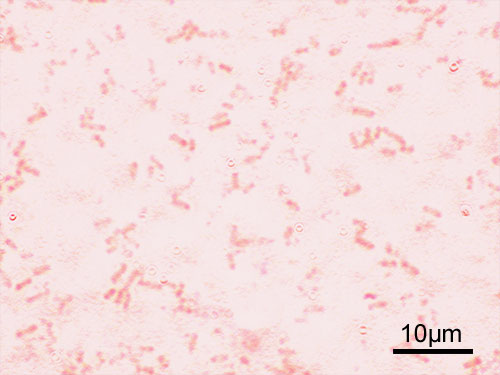
| Gram staining properties | Negative |
| Shape | Rod |
| Mobility | No |
| Flagellar presence | Yes |
| Number of membranes | 2 |

Image source: Wikipedia/Wikimedia
| Ecology, Host, and Life Cycle | |
|---|---|
| Oxygen requirements | Facultative anaerobe |
| Optimal temperature | 37 |
| Temperature range | Mesophilic |
| Habitat | HostAssociated |
| Biotic relationship | Free living |
| Host(s) | Not Available |
| Cell arrangement | Pairs - Singles |
| Sporulation | Not Available |
| Energy source | Chemoorganotroph |
| Pathogenicity | Not Available |
Gene Summary
Adenine Count
1128216 bp
Thymine Count
1123711 bp
Guanine Count
1187326 bp
Cytosine Count
1174304 bp
Genome Length
4613557 bp
Protein-coding Genes
5602 genes
Non-Coding Genes
396 genes
# of Chromosomes/Plasmids
2
Genes
| Name | Locus Tag | UniProt ID | Strand Orientation | Gene Start/End | Protein Molecular Weight |
|---|---|---|---|---|---|
| hypothetical protein | SD1617_3701 | Not Available | Negative | 2969466 - 2969657 | 6680.75 |
| uncharacterized yach domain protein | SD1617_3702 | Not Available | Positive | 2969698 - 2970327 | 24570.4 |
| dihydrolipoyl dehydrogenase | SD1617_3703 | Not Available | Negative | 2970398 - 2971822 | 50677.4 |
| dihydrolipoyllysine-residue acetyltransferase e2 component of pyruvate dehydrogenase complex | SD1617_3704 | Not Available | Negative | 2972030 - 2973910 | 65786.3 |
| pyruvate dehydrogenase (acetyl-transferring), homodimeric type | SD1617_3705 | Not Available | Negative | 2973925 - 2976588 | 99686.2 |
| pyruvate dehydrogenase complex repressor | SD1617_3706 | Not Available | Negative | 2976749 - 2977513 | 29374.2 |
| aromatic amino acid transport protein arop | SD1617_3707 | Not Available | Positive | 2978057 - 2979427 | 49561.9 |
| regulates ampc | SD1617_3708 | Not Available | Negative | 2979470 - 2980324 | 32070.8 |
| protein ampd | SD1617_3709 | Not Available | Negative | 2980321 - 2980872 | 20529.1 |
| nicotinate-nucleotide diphosphorylase | SD1617_3710 | Not Available | Positive | 2980960 - 2981853 | 32788.0 |
Pathways
0 pathways
No pathways found
No metabolic pathways have been associated with this bacterium yet.
Health Effects
No health effects information available for this bacterium.