Kingdom
Pseudomonadati
Phylum
Pseudomonadota
Class
Gammaproteobacteria
Order
Enterobacterales
Family
Enterobacteriaceae
Genus
Shigella
Description
Taxonomy
| Kingdom | Pseudomonadati |
|---|---|
| Phylum | Pseudomonadota |
| Class | Gammaproteobacteria |
| Order | Enterobacterales |
| Family | Enterobacteriaceae |
| Genus | Shigella |
| Species | Shigella dysenteriae |
| Strain | 1617 |
Profile
| Physiology | |
|---|---|
| Gram staining properties | Negative |
| Shape | Rod |
| Mobility | No |
| Flagellar presence | Yes |
| Number of membranes | 2 |

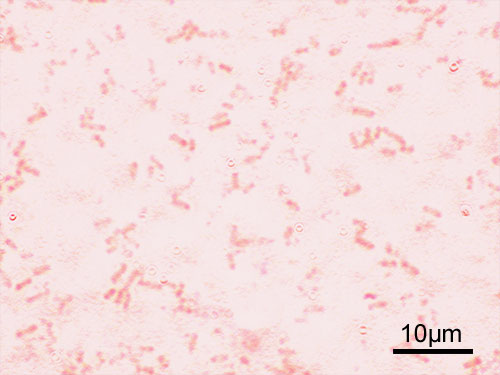
Image source: Wikipedia/Wikimedia
| Ecology, Host, and Life Cycle | |
|---|---|
| Oxygen requirements | Facultative anaerobe |
| Optimal temperature | 37 |
| Temperature range | Mesophilic |
| Habitat | HostAssociated |
| Biotic relationship | Free living |
| Host(s) | Not Available |
| Cell arrangement | Pairs - Singles |
| Sporulation | Not Available |
| Energy source | Chemoorganotroph |
| Pathogenicity | Not Available |
Gene Summary
Adenine Count
1128216 bp
Thymine Count
1123711 bp
Guanine Count
1187326 bp
Cytosine Count
1174304 bp
Genome Length
4613557 bp
Protein-coding Genes
5602 genes
Non-Coding Genes
396 genes
# of Chromosomes/Plasmids
2
Genes
| Name | Locus Tag | UniProt ID | Strand Orientation | Gene Start/End | Protein Molecular Weight |
|---|---|---|---|---|---|
| ferrichrome transport system permease protein fhub | SD1617_3671 | Not Available | Negative | 2946003 - 2947985 | 70503.8 |
| ferrichrome-binding periplasmic protein | SD1617_3672 | Not Available | Negative | 2947982 - 2948827 | 31349.1 |
| ferrichrome transport atp-binding protein fhuc | SD1617_3673 | Not Available | Negative | 2948872 - 2949669 | 28872.2 |
| ferrichrome-iron receptor | SD1617_3674 | Not Available | Negative | 2949720 - 2951885 | 79505.2 |
| hypothe | SD1617_3675 | Not Available | Positive | 2951984 - 2952118 | 4968.9 |
| penicillin-binding protein 1b | SD1617_3676 | Not Available | Negative | 2952183 - 2954717 | 94327.1 |
| putative atp-dependent helicase | SD1617_3677 | Not Available | Negative | 2955108 - 2955371 | 9771.84 |
| atp-dependent helicase hrpb | SD1617_3678 | Not Available | Negative | 2955465 - 2957342 | 68184.1 |
| 2'-5' rna ligase | SD1617_3679 | Not Available | Positive | 2957416 - 2957946 | 19953.1 |
| sugar fermentation stimulation protein | SD1617_3680 | Not Available | Positive | 2957961 - 2958665 | 26187.2 |
Pathways
0 pathways
No pathways found
No metabolic pathways have been associated with this bacterium yet.
Health Effects
No health effects information available for this bacterium.