Kingdom
Pseudomonadati
Phylum
Pseudomonadota
Class
Gammaproteobacteria
Order
Enterobacterales
Family
Enterobacteriaceae
Genus
Shigella
Description
Taxonomy
| Kingdom | Pseudomonadati |
|---|---|
| Phylum | Pseudomonadota |
| Class | Gammaproteobacteria |
| Order | Enterobacterales |
| Family | Enterobacteriaceae |
| Genus | Shigella |
| Species | Shigella dysenteriae |
| Strain | 1617 |
Profile
| Physiology | |
|---|---|
| Gram staining properties | Negative |
| Shape | Rod |
| Mobility | No |
| Flagellar presence | Yes |
| Number of membranes | 2 |

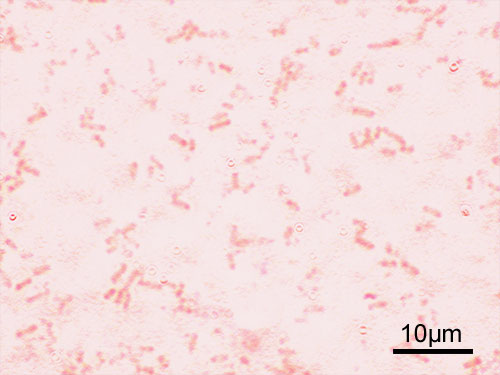
Image source: Wikipedia/Wikimedia
| Ecology, Host, and Life Cycle | |
|---|---|
| Oxygen requirements | Facultative anaerobe |
| Optimal temperature | 37 |
| Temperature range | Mesophilic |
| Habitat | HostAssociated |
| Biotic relationship | Free living |
| Host(s) | Not Available |
| Cell arrangement | Pairs - Singles |
| Sporulation | Not Available |
| Energy source | Chemoorganotroph |
| Pathogenicity | Not Available |
Gene Summary
Adenine Count
1128216 bp
Thymine Count
1123711 bp
Guanine Count
1187326 bp
Cytosine Count
1174304 bp
Genome Length
4613557 bp
Protein-coding Genes
5602 genes
Non-Coding Genes
396 genes
# of Chromosomes/Plasmids
2
Genes
| Name | Locus Tag | UniProt ID | Strand Orientation | Gene Start/End | Protein Molecular Weight |
|---|---|---|---|---|---|
| putative electron transfer flavosubunit ygcr domain protein | SD1617_2622 | Not Available | Positive | 2152597 - 2152839 | 8976.2 |
| putative electron transfer flavoprotein subunit ygcq | SD1617_2623 | Not Available | Positive | 2152836 - 2153384 | 19671.5 |
| putative electron transfer flavosubunit ygcq domain protein | SD1617_2624 | Not Available | Positive | 2153394 - 2153696 | 10238.4 |
| glycerol-3-phosphate responsive antiterminator family protein | SD1617_2625 | Not Available | Negative | 2153844 - 2154419 | 20821.6 |
| hypothetical protein | SD1617_2626 | Not Available | Negative | 2154436 - 2154696 | 9627.48 |
| putative electron transfer flavoprotein-quinone oxidoreductase ygcn | SD1617_2627 | Not Available | Negative | 2154687 - 2155958 | 46357.8 |
| queuosine biosynthesis protein qued | SD1617_2628 | Not Available | Negative | 2156036 - 2156398 | 13656.4 |
| hypothetical protein | SD1617_2629 | Not Available | Positive | 2156391 - 2156504 | 4205.18 |
| sulfite reductase flavoprotein, alpha-component | SD1617_2630 | Not Available | Positive | 2156717 - 2158516 | 66416.5 |
| sulfite reductase hemoprotein, beta-component | SD1617_2631 | Not Available | Positive | 2158576 - 2160228 | 61782.2 |
Pathways
0 pathways
No pathways found
No metabolic pathways have been associated with this bacterium yet.
Health Effects
No health effects information available for this bacterium.