Kingdom
Pseudomonadati
Phylum
Pseudomonadota
Class
Gammaproteobacteria
Order
Enterobacterales
Family
Enterobacteriaceae
Genus
Shigella
Description
Taxonomy
| Kingdom | Pseudomonadati |
|---|---|
| Phylum | Pseudomonadota |
| Class | Gammaproteobacteria |
| Order | Enterobacterales |
| Family | Enterobacteriaceae |
| Genus | Shigella |
| Species | Shigella dysenteriae |
| Strain | 1617 |
Profile
| Physiology | |
|---|---|
| Gram staining properties | Negative |
| Shape | Rod |
| Mobility | No |
| Flagellar presence | Yes |
| Number of membranes | 2 |

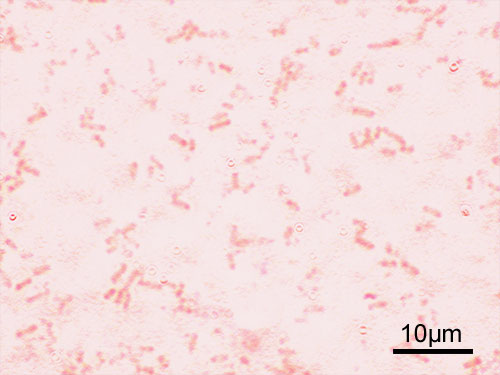
Image source: Wikipedia/Wikimedia
| Ecology, Host, and Life Cycle | |
|---|---|
| Oxygen requirements | Facultative anaerobe |
| Optimal temperature | 37 |
| Temperature range | Mesophilic |
| Habitat | HostAssociated |
| Biotic relationship | Free living |
| Host(s) | Not Available |
| Cell arrangement | Pairs - Singles |
| Sporulation | Not Available |
| Energy source | Chemoorganotroph |
| Pathogenicity | Not Available |
Gene Summary
Adenine Count
1128216 bp
Thymine Count
1123711 bp
Guanine Count
1187326 bp
Cytosine Count
1174304 bp
Genome Length
4613557 bp
Protein-coding Genes
5602 genes
Non-Coding Genes
396 genes
# of Chromosomes/Plasmids
2
Genes
| Name | Locus Tag | UniProt ID | Strand Orientation | Gene Start/End | Protein Molecular Weight |
|---|---|---|---|---|---|
| ribosomal protein s21 | SD1617_1842 | Not Available | Positive | 1521100 - 1521315 | 8500.42 |
| dna primase | SD1617_1843 | Not Available | Positive | 1521427 - 1523172 | 65598.5 |
| hypothetical protein | SD1617_1844 | Not Available | Positive | 1523186 - 1523308 | 4564.46 |
| rna polymerase sigma factor rpod | SD1617_1845 | Not Available | Positive | 1523367 - 1525208 | 70183.2 |
| uracil dna glycosylase superfamily protein | SD1617_1846 | Not Available | Negative | 1525287 - 1525793 | 18660.4 |
| Trna-met | Not Available | Not Available | Positive | 1525918 - 1525993 | Not Available |
| siderophore-interacting family protein | SD1617_1848 | Not Available | Negative | 1526047 - 1526811 | 28990.1 |
| transcriptional regulator padr-like family protein | SD1617_1849 | Not Available | Positive | 1527099 - 1527722 | 23388.7 |
| aerotaxis receptor | SD1617_1850 | Not Available | Negative | 1527829 - 1529349 | 55117.9 |
| putrescine aminotransferase | SD1617_1851 | Not Available | Positive | 1529857 - 1530624 | 27501.4 |
Pathways
0 pathways
No pathways found
No metabolic pathways have been associated with this bacterium yet.
Health Effects
No health effects information available for this bacterium.