Kingdom
Pseudomonadati
Phylum
Pseudomonadota
Class
Gammaproteobacteria
Order
Enterobacterales
Family
Enterobacteriaceae
Genus
Shigella
Description
Taxonomy
| Kingdom | Pseudomonadati |
|---|---|
| Phylum | Pseudomonadota |
| Class | Gammaproteobacteria |
| Order | Enterobacterales |
| Family | Enterobacteriaceae |
| Genus | Shigella |
| Species | Shigella dysenteriae |
| Strain | 1617 |
Profile
| Physiology | |
|---|---|
| Gram staining properties | Negative |
| Shape | Rod |
| Mobility | No |
| Flagellar presence | Yes |
| Number of membranes | 2 |

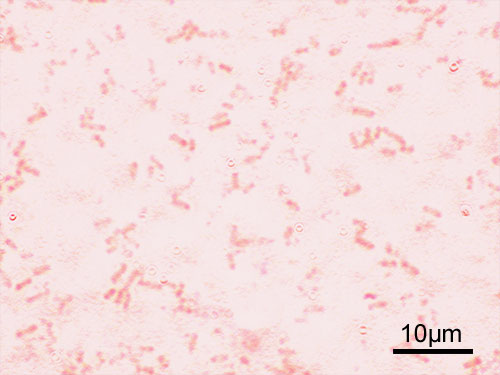
Image source: Wikipedia/Wikimedia
| Ecology, Host, and Life Cycle | |
|---|---|
| Oxygen requirements | Facultative anaerobe |
| Optimal temperature | 37 |
| Temperature range | Mesophilic |
| Habitat | HostAssociated |
| Biotic relationship | Free living |
| Host(s) | Not Available |
| Cell arrangement | Pairs - Singles |
| Sporulation | Not Available |
| Energy source | Chemoorganotroph |
| Pathogenicity | Not Available |
Gene Summary
Adenine Count
1128216 bp
Thymine Count
1123711 bp
Guanine Count
1187326 bp
Cytosine Count
1174304 bp
Genome Length
4613557 bp
Protein-coding Genes
5602 genes
Non-Coding Genes
396 genes
# of Chromosomes/Plasmids
2
Genes
| Name | Locus Tag | UniProt ID | Strand Orientation | Gene Start/End | Protein Molecular Weight |
|---|---|---|---|---|---|
| glutamate decarboxylase isozyme domain protein | SD1617_1712 | Not Available | Positive | 1420800 - 1420967 | 6113.7 |
| mannitol-specific cryptic phosphotransferase enzyme iia component | SD1617_1713 | Not Available | Positive | 1420982 - 1421425 | 16107.2 |
| pts system mannitol-specific eiicb component | SD1617_1714 | Not Available | Positive | 1421453 - 1422841 | 48955.1 |
| l-sorbose 1-phosphate reductase | SD1617_1715 | Not Available | Positive | 1422856 - 1424133 | 45879.2 |
| bacterial fructose-1,6-bisphosphatase, glpx-encoded family protein | SD1617_1716 | Not Available | Positive | 1424130 - 1424417 | 10151.3 |
| fructose-1,6-bisphosphatase, class ii | SD1617_1717 | Not Available | Positive | 1424436 - 1425095 | 23520.4 |
| mannitol repressor family protein | SD1617_1718 | Not Available | Positive | 1425117 - 1425626 | 19173.7 |
| uncharacterized protein yggc | SD1617_1719 | Not Available | Positive | 1425623 - 1426336 | 26850.1 |
| abc transporter family protein | SD1617_1720 | Not Available | Negative | 1426308 - 1426985 | 25004.1 |
| abc transporter, atp-binding domain protein | SD1617_1721 | Not Available | Negative | 1426979 - 1427206 | 8654.77 |
Pathways
0 pathways
No pathways found
No metabolic pathways have been associated with this bacterium yet.
Health Effects
No health effects information available for this bacterium.