Kingdom
Pseudomonadati
Phylum
Pseudomonadota
Class
Gammaproteobacteria
Order
Enterobacterales
Family
Enterobacteriaceae
Genus
Shigella
Description
Taxonomy
| Kingdom | Pseudomonadati |
|---|---|
| Phylum | Pseudomonadota |
| Class | Gammaproteobacteria |
| Order | Enterobacterales |
| Family | Enterobacteriaceae |
| Genus | Shigella |
| Species | Shigella dysenteriae |
| Strain | 1617 |
Profile
| Physiology | |
|---|---|
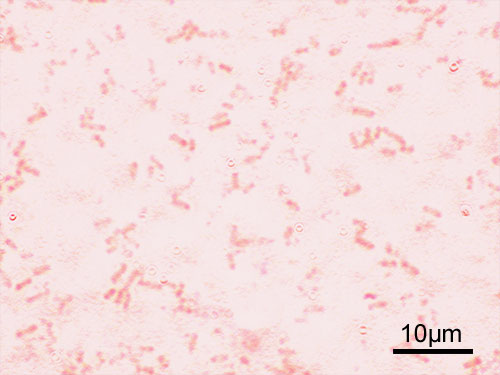
| Gram staining properties | Negative |
| Shape | Rod |
| Mobility | No |
| Flagellar presence | Yes |
| Number of membranes | 2 |

Image source: Wikipedia/Wikimedia
| Ecology, Host, and Life Cycle | |
|---|---|
| Oxygen requirements | Facultative anaerobe |
| Optimal temperature | 37 |
| Temperature range | Mesophilic |
| Habitat | HostAssociated |
| Biotic relationship | Free living |
| Host(s) | Not Available |
| Cell arrangement | Pairs - Singles |
| Sporulation | Not Available |
| Energy source | Chemoorganotroph |
| Pathogenicity | Not Available |
Gene Summary
Adenine Count
1128216 bp
Thymine Count
1123711 bp
Guanine Count
1187326 bp
Cytosine Count
1174304 bp
Genome Length
4613557 bp
Protein-coding Genes
5602 genes
Non-Coding Genes
396 genes
# of Chromosomes/Plasmids
2
Genes
| Name | Locus Tag | UniProt ID | Strand Orientation | Gene Start/End | Protein Molecular Weight |
|---|---|---|---|---|---|
| glutamate decarboxylase isozyme | SD1617_1301 | Not Available | Negative | 1081853 - 1082131 | 10372.7 |
| hypothetical protein | SD1617_1302 | Not Available | Negative | 1082155 - 1082319 | 6123.78 |
| insertion element is1 1/5/6 protein insb | SD1617_1303 | Not Available | Positive | 1082284 - 1082508 | 8410.02 |
| insertion element iso-is1n protein insb | SD1617_1304 | Not Available | Positive | 1082505 - 1082720 | 8498.39 |
| upf0214 yfew domain protein | SD1617_1305 | Not Available | Negative | 1082730 - 1083515 | 29074.7 |
| phosphotransferase system, eiic family protein | SD1617_1306 | Not Available | Negative | 1083646 - 1085070 | 49843.1 |
| n-acetylmuramic acid 6-phosphate etherase | SD1617_1307 | Not Available | Negative | 1085074 - 1085970 | 31127.8 |
| helix-turn-helix domain, rpir family protein | SD1617_1308 | Not Available | Positive | 1086134 - 1086976 | 30788.1 |
| glutamate decarboxylase isozyme | SD1617_1309 | Not Available | Negative | 1086927 - 1087133 | 7548.45 |
| hypothetical protein | SD1617_1310 | Not Available | Negative | 1087207 - 1087320 | 4566.72 |
Pathways
0 pathways
No pathways found
No metabolic pathways have been associated with this bacterium yet.
Health Effects
No health effects information available for this bacterium.