Kingdom
Pseudomonadati
Phylum
Pseudomonadota
Class
Gammaproteobacteria
Order
Enterobacterales
Family
Enterobacteriaceae
Genus
Shigella
Description
Taxonomy
| Kingdom | Pseudomonadati |
|---|---|
| Phylum | Pseudomonadota |
| Class | Gammaproteobacteria |
| Order | Enterobacterales |
| Family | Enterobacteriaceae |
| Genus | Shigella |
| Species | Shigella dysenteriae |
| Strain | 1617 |
Profile
| Physiology | |
|---|---|
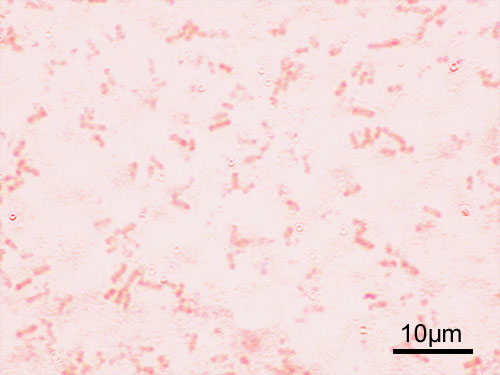
| Gram staining properties | Negative |
| Shape | Rod |
| Mobility | No |
| Flagellar presence | Yes |
| Number of membranes | 2 |

Image source: Wikipedia/Wikimedia
| Ecology, Host, and Life Cycle | |
|---|---|
| Oxygen requirements | Facultative anaerobe |
| Optimal temperature | 37 |
| Temperature range | Mesophilic |
| Habitat | HostAssociated |
| Biotic relationship | Free living |
| Host(s) | Not Available |
| Cell arrangement | Pairs - Singles |
| Sporulation | Not Available |
| Energy source | Chemoorganotroph |
| Pathogenicity | Not Available |
Gene Summary
Adenine Count
1128216 bp
Thymine Count
1123711 bp
Guanine Count
1187326 bp
Cytosine Count
1174304 bp
Genome Length
4613557 bp
Protein-coding Genes
5602 genes
Non-Coding Genes
396 genes
# of Chromosomes/Plasmids
2
Genes
| Name | Locus Tag | UniProt ID | Strand Orientation | Gene Start/End | Protein Molecular Weight |
|---|---|---|---|---|---|
| is1 family transposase | ASD1617_RS00885 | Not Available | Positive | 156753 - 156821 | 2351.73 |
| winged helix-turn-helix domain-containing protein | ASD1617_RS00890 | Not Available | Positive | 156877 - 156990 | 4509.67 |
| 2-amino-4-hydroxy-6- hydroxymethyldihydropteridine diphosphokinase | ASD1617_RS00895 | Not Available | Negative | 157060 - 157539 | 18019.7 |
| polynucleotide adenylyltransferase pcnb | ASD1617_RS00900 | Not Available | Negative | 157536 - 158954 | 54658.1 |
| trna glutamyl-q(34) synthetase gluqrs | ASD1617_RS00905 | Not Available | Negative | 158993 - 159889 | 33611.8 |
| rna polymerase-binding protein dksa | ASD1617_RS00910 | Not Available | Negative | 159956 - 160411 | 17528.7 |
| dna/rna nuclease sfsa | ASD1617_RS00915 | Not Available | Negative | 160589 - 161293 | 26187.2 |
| rna 2',3'-cyclic phosphodiesterase | ASD1617_RS00920 | Not Available | Negative | 161308 - 161838 | 19953.1 |
| winged helix-turn-helix domain-containing protein | ASD1617_RS00925 | Not Available | Positive | 161912 - 164287 | 86681.4 |
| bifunctional glycosyl transferase/transpeptidase | ASD1617_RS00930 | Not Available | Positive | 164408 - 166942 | 94327.1 |
Pathways
0 pathways
No pathways found
No metabolic pathways have been associated with this bacterium yet.
Health Effects
No health effects information available for this bacterium.