Kingdom
Pseudomonadati
Phylum
Pseudomonadota
Class
Gammaproteobacteria
Order
Enterobacterales
Family
Enterobacteriaceae
Genus
Shigella
Description
Taxonomy
| Kingdom | Pseudomonadati |
|---|---|
| Phylum | Pseudomonadota |
| Class | Gammaproteobacteria |
| Order | Enterobacterales |
| Family | Enterobacteriaceae |
| Genus | Shigella |
| Species | Shigella dysenteriae |
| Strain | 1617 |
Profile
| Physiology | |
|---|---|
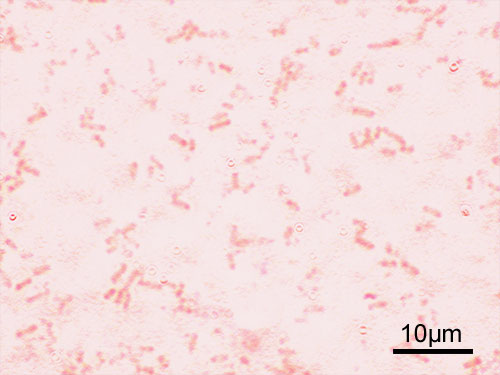
| Gram staining properties | Negative |
| Shape | Rod |
| Mobility | No |
| Flagellar presence | Yes |
| Number of membranes | 2 |

Image source: Wikipedia/Wikimedia
| Ecology, Host, and Life Cycle | |
|---|---|
| Oxygen requirements | Facultative anaerobe |
| Optimal temperature | 37 |
| Temperature range | Mesophilic |
| Habitat | HostAssociated |
| Biotic relationship | Free living |
| Host(s) | Not Available |
| Cell arrangement | Pairs - Singles |
| Sporulation | Not Available |
| Energy source | Chemoorganotroph |
| Pathogenicity | Not Available |
Gene Summary
Adenine Count
1128216 bp
Thymine Count
1123711 bp
Guanine Count
1187326 bp
Cytosine Count
1174304 bp
Genome Length
4613557 bp
Protein-coding Genes
5602 genes
Non-Coding Genes
396 genes
# of Chromosomes/Plasmids
2
Genes
| Name | Locus Tag | UniProt ID | Strand Orientation | Gene Start/End | Protein Molecular Weight |
|---|---|---|---|---|---|
| alpha-d-ribose 1-methylphosphonate 5-triphosphate synthase subunit phni | ASD1617_RS23865 | Not Available | Positive | 3799039 - 3800103 | 38970.2 |
| alpha-d-ribose 1-methylphosphonate 5-phosphate c-p-lyase phnj | ASD1617_RS23870 | Not Available | Positive | 3800096 - 3800941 | 31853.9 |
| phosphonate c-p lyase system protein phnk | ASD1617_RS23875 | Not Available | Positive | 3800938 - 3801696 | 27833.6 |
| phosphonate c-p lyase system protein phnl | ASD1617_RS23880 | Not Available | Positive | 3801807 - 3802487 | 24690.9 |
| alpha-d-ribose 1-methylphosphonate 5-triphosphate diphosphatase | ASD1617_RS23885 | Not Available | Positive | 3802484 - 3803536 | 38864.1 |
| ribose 1,5-bisphosphokinase | ASD1617_RS23890 | Not Available | Positive | 3803536 - 3804093 | 20689.8 |
| aminoalkylphosphonate n-acetyltransferase | ASD1617_RS23895 | Not Available | Positive | 3804080 - 3804514 | 16527.8 |
| phosphonate metabolism protein phnp | ASD1617_RS23900 | Not Available | Positive | 3804516 - 3805274 | 28003.5 |
| ddrrrql repeat protein yjdp | ASD1617_RS23905 | Not Available | Negative | 3805350 - 3805679 | 13352.1 |
| gnat family n-acetyltransferase | ASD1617_RS23910 | Not Available | Negative | 3805748 - 3806380 | 23731.4 |
Pathways
0 pathways
No pathways found
No metabolic pathways have been associated with this bacterium yet.
Health Effects
No health effects information available for this bacterium.