Kingdom
Pseudomonadati
Phylum
Pseudomonadota
Class
Gammaproteobacteria
Order
Enterobacterales
Family
Enterobacteriaceae
Genus
Shigella
Description
Taxonomy
| Kingdom | Pseudomonadati |
|---|---|
| Phylum | Pseudomonadota |
| Class | Gammaproteobacteria |
| Order | Enterobacterales |
| Family | Enterobacteriaceae |
| Genus | Shigella |
| Species | Shigella dysenteriae |
| Strain | 1617 |
Profile
| Physiology | |
|---|---|
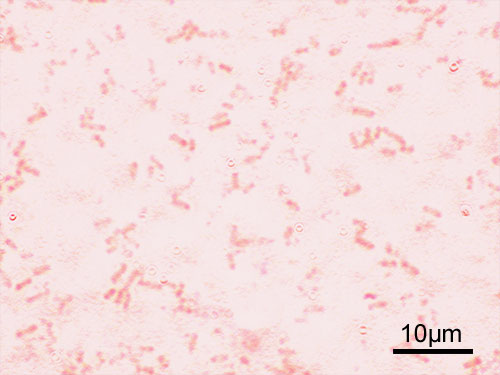
| Gram staining properties | Negative |
| Shape | Rod |
| Mobility | No |
| Flagellar presence | Yes |
| Number of membranes | 2 |

Image source: Wikipedia/Wikimedia
| Ecology, Host, and Life Cycle | |
|---|---|
| Oxygen requirements | Facultative anaerobe |
| Optimal temperature | 37 |
| Temperature range | Mesophilic |
| Habitat | HostAssociated |
| Biotic relationship | Free living |
| Host(s) | Not Available |
| Cell arrangement | Pairs - Singles |
| Sporulation | Not Available |
| Energy source | Chemoorganotroph |
| Pathogenicity | Not Available |
Gene Summary
Adenine Count
1128216 bp
Thymine Count
1123711 bp
Guanine Count
1187326 bp
Cytosine Count
1174304 bp
Genome Length
4613557 bp
Protein-coding Genes
5602 genes
Non-Coding Genes
396 genes
# of Chromosomes/Plasmids
2
Genes
| Name | Locus Tag | UniProt ID | Strand Orientation | Gene Start/End | Protein Molecular Weight |
|---|---|---|---|---|---|
| sec-independent protein translocase subunit tata | ASD1617_RS22735 | Not Available | Negative | 3587314 - 3587583 | 9664.5 |
| ubiquinone biosynthesis regulatory protein kinase ubib | ASD1617_RS22740 | Not Available | Negative | 3587662 - 3589302 | 63206.4 |
| ubiquinone biosynthesis protein ubij | ASD1617_RS22745 | Not Available | Negative | 3589299 - 3589904 | 22123.8 |
| winged helix-turn-helix domain-containing protein | ASD1617_RS22750 | Not Available | Negative | 3589922 - 3590245 | 12008.5 |
| dna recombination protein rmuc | ASD1617_RS22755 | Not Available | Negative | 3590340 - 3591767 | 54767.6 |
| uridine phosphorylase | ASD1617_RS22760 | Not Available | Negative | 3591908 - 3592669 | 27151.7 |
| dienelactone hydrolase family protein | ASD1617_RS22765 | Not Available | Positive | 3592931 - 3593746 | 29442.8 |
| 5-methyltetrahydropteroyltriglutamate-- homocysteine s-methyltransferase | ASD1617_RS22770 | Not Available | Negative | 3593786 - 3596047 | 84748.2 |
| hth-type transcriptional regulator metr | ASD1617_RS22775 | Not Available | Positive | 3596283 - 3597236 | 35644.1 |
| winged helix-turn-helix domain-containing protein | ASD1617_RS22780 | Not Available | Negative | 3597124 - 3598022 | 33508.8 |
Pathways
0 pathways
No pathways found
No metabolic pathways have been associated with this bacterium yet.
Health Effects
No health effects information available for this bacterium.