Kingdom
Pseudomonadati
Phylum
Pseudomonadota
Class
Gammaproteobacteria
Order
Enterobacterales
Family
Enterobacteriaceae
Genus
Shigella
Description
Taxonomy
| Kingdom | Pseudomonadati |
|---|---|
| Phylum | Pseudomonadota |
| Class | Gammaproteobacteria |
| Order | Enterobacterales |
| Family | Enterobacteriaceae |
| Genus | Shigella |
| Species | Shigella dysenteriae |
| Strain | 1617 |
Profile
| Physiology | |
|---|---|
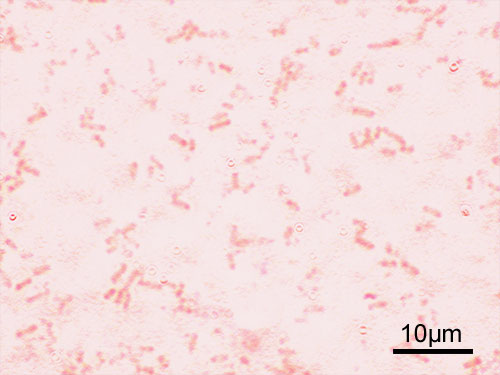
| Gram staining properties | Negative |
| Shape | Rod |
| Mobility | No |
| Flagellar presence | Yes |
| Number of membranes | 2 |

Image source: Wikipedia/Wikimedia
| Ecology, Host, and Life Cycle | |
|---|---|
| Oxygen requirements | Facultative anaerobe |
| Optimal temperature | 37 |
| Temperature range | Mesophilic |
| Habitat | HostAssociated |
| Biotic relationship | Free living |
| Host(s) | Not Available |
| Cell arrangement | Pairs - Singles |
| Sporulation | Not Available |
| Energy source | Chemoorganotroph |
| Pathogenicity | Not Available |
Gene Summary
Adenine Count
1128216 bp
Thymine Count
1123711 bp
Guanine Count
1187326 bp
Cytosine Count
1174304 bp
Genome Length
4613557 bp
Protein-coding Genes
5602 genes
Non-Coding Genes
396 genes
# of Chromosomes/Plasmids
2
Genes
| Name | Locus Tag | UniProt ID | Strand Orientation | Gene Start/End | Protein Molecular Weight |
|---|---|---|---|---|---|
| 30s ribosome-binding factor rbfa | ASD1617_RS19600 | Not Available | Negative | 3053575 - 3053976 | 15155.4 |
| translation initiation factor if-2 | ASD1617_RS19605 | Not Available | Negative | 3054140 - 3056812 | 97385.6 |
| transcription termination factor nusa | ASD1617_RS19610 | Not Available | Negative | 3056837 - 3058324 | 54918.0 |
| ribosome maturation factor rimp | ASD1617_RS19615 | Not Available | Negative | 3058352 - 3058804 | 16651.9 |
| Trna-met | Not Available | Not Available | Positive | 3059011 - 3059087 | Not Available |
| argininosuccinate synthase | ASD1617_RS19625 | Not Available | Positive | 3059435 - 3060778 | 49914.3 |
| phosphoethanolamine transferase | ASD1617_RS19630 | Not Available | Negative | 3060786 - 3062393 | 60008.7 |
| winged helix-turn-helix domain-containing protein | ASD1617_RS19635 | Not Available | Negative | 3062464 - 3063159 | 25894.1 |
| Trna-leu | Not Available | Not Available | Positive | 3063637 - 3063723 | Not Available |
| preprotein translocase subunit secg | ASD1617_RS19655 | Not Available | Negative | 3063738 - 3064070 | 11378.9 |
Pathways
0 pathways
No pathways found
No metabolic pathways have been associated with this bacterium yet.
Health Effects
No health effects information available for this bacterium.