Kingdom
Pseudomonadati
Phylum
Pseudomonadota
Class
Gammaproteobacteria
Order
Enterobacterales
Family
Enterobacteriaceae
Genus
Shigella
Description
Taxonomy
| Kingdom | Pseudomonadati |
|---|---|
| Phylum | Pseudomonadota |
| Class | Gammaproteobacteria |
| Order | Enterobacterales |
| Family | Enterobacteriaceae |
| Genus | Shigella |
| Species | Shigella dysenteriae |
| Strain | 1617 |
Profile
| Physiology | |
|---|---|
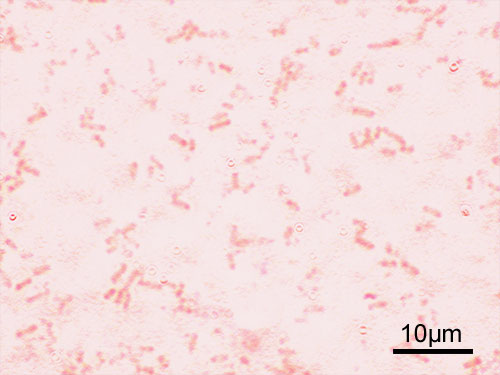
| Gram staining properties | Negative |
| Shape | Rod |
| Mobility | No |
| Flagellar presence | Yes |
| Number of membranes | 2 |

Image source: Wikipedia/Wikimedia
| Ecology, Host, and Life Cycle | |
|---|---|
| Oxygen requirements | Facultative anaerobe |
| Optimal temperature | 37 |
| Temperature range | Mesophilic |
| Habitat | HostAssociated |
| Biotic relationship | Free living |
| Host(s) | Not Available |
| Cell arrangement | Pairs - Singles |
| Sporulation | Not Available |
| Energy source | Chemoorganotroph |
| Pathogenicity | Not Available |
Gene Summary
Adenine Count
1128216 bp
Thymine Count
1123711 bp
Guanine Count
1187326 bp
Cytosine Count
1174304 bp
Genome Length
4613557 bp
Protein-coding Genes
5602 genes
Non-Coding Genes
396 genes
# of Chromosomes/Plasmids
2
Genes
| Name | Locus Tag | UniProt ID | Strand Orientation | Gene Start/End | Protein Molecular Weight |
|---|---|---|---|---|---|
| flap endonuclease xni | ASD1617_RS17700 | Not Available | Positive | 2739217 - 2739972 | 28167.7 |
| lactaldehyde reductase | ASD1617_RS17705 | Not Available | Negative | 2740027 - 2741175 | 40534.8 |
| winged helix-turn-helix domain-containing protein | ASD1617_RS17710 | Not Available | Negative | 2741203 - 2741849 | 24186.4 |
| winged helix-turn-helix domain-containing protein | ASD1617_RS17715 | Not Available | Positive | 2742397 - 2742954 | 20264.8 |
| hypothetical protein | ASD1617_RS29965 | Not Available | Negative | 2742883 - 2743119 | 8916.18 |
| winged helix-turn-helix domain-containing protein | ASD1617_RS17725 | Not Available | Positive | 2743015 - 2743341 | 12631.8 |
| hypothetical protein | ASD1617_RS29970 | Not Available | Negative | 2743299 - 2743532 | 8475.48 |
| winged helix-turn-helix domain-containing protein | ASD1617_RS17735 | Not Available | Positive | 2743428 - 2743847 | 15495.9 |
| winged helix-turn-helix domain-containing protein | ASD1617_RS17740 | Not Available | Positive | 2743864 - 2744625 | 27474.1 |
| l-fucose isomerase | ASD1617_RS17745 | Not Available | Positive | 2744658 - 2746433 | 65129.6 |
Pathways
0 pathways
No pathways found
No metabolic pathways have been associated with this bacterium yet.
Health Effects
No health effects information available for this bacterium.