Kingdom
Pseudomonadati
Phylum
Pseudomonadota
Class
Gammaproteobacteria
Order
Enterobacterales
Family
Enterobacteriaceae
Genus
Shigella
Description
Taxonomy
| Kingdom | Pseudomonadati |
|---|---|
| Phylum | Pseudomonadota |
| Class | Gammaproteobacteria |
| Order | Enterobacterales |
| Family | Enterobacteriaceae |
| Genus | Shigella |
| Species | Shigella dysenteriae |
| Strain | 1617 |
Profile
| Physiology | |
|---|---|
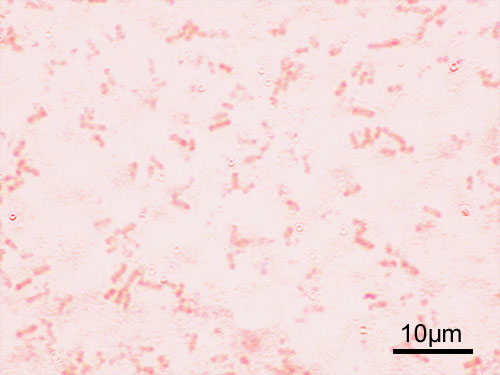
| Gram staining properties | Negative |
| Shape | Rod |
| Mobility | No |
| Flagellar presence | Yes |
| Number of membranes | 2 |

Image source: Wikipedia/Wikimedia
| Ecology, Host, and Life Cycle | |
|---|---|
| Oxygen requirements | Facultative anaerobe |
| Optimal temperature | 37 |
| Temperature range | Mesophilic |
| Habitat | HostAssociated |
| Biotic relationship | Free living |
| Host(s) | Not Available |
| Cell arrangement | Pairs - Singles |
| Sporulation | Not Available |
| Energy source | Chemoorganotroph |
| Pathogenicity | Not Available |
Gene Summary
Adenine Count
1128216 bp
Thymine Count
1123711 bp
Guanine Count
1187326 bp
Cytosine Count
1174304 bp
Genome Length
4613557 bp
Protein-coding Genes
5602 genes
Non-Coding Genes
396 genes
# of Chromosomes/Plasmids
2
Genes
| Name | Locus Tag | UniProt ID | Strand Orientation | Gene Start/End | Protein Molecular Weight |
|---|---|---|---|---|---|
| winged helix-turn-helix domain-containing protein | ASD1617_RS09265 | Not Available | Positive | 1427250 - 1429296 | 68383.2 |
| 2-oxo-tetronate isomerase | ASD1617_RS09270 | Not Available | Negative | 1429341 - 1429859 | 18265.8 |
| winged helix-turn-helix domain-containing protein | ASD1617_RS09275 | Not Available | Positive | 1430135 - 1430528 | 14126.5 |
| diguanylate cyclase dgcz | ASD1617_RS09280 | Not Available | Positive | 1430783 - 1431673 | 33909.6 |
| protein mgts | ASD1617_RS09285 | Not Available | Negative | 1431891 - 1431986 | 3523.39 |
| winged helix-turn-helix domain-containing protein | ASD1617_RS09290 | Not Available | Positive | 1432081 - 1432791 | 23653.1 |
| efflux mfs transporter ydee | ASD1617_RS09295 | Not Available | Negative | 1432927 - 1434114 | 42649.4 |
| o-acetylserine/cysteine exporter | ASD1617_RS09300 | Not Available | Positive | 1434309 - 1435208 | 32254.2 |
| winged helix-turn-helix domain-containing protein | ASD1617_RS09305 | Not Available | Negative | 1435239 - 1435456 | 8567.7 |
| mdr efflux pump acrab transcriptional activator mara | ASD1617_RS09310 | Not Available | Negative | 1435488 - 1435871 | 15157.0 |
Pathways
0 pathways
No pathways found
No metabolic pathways have been associated with this bacterium yet.
Health Effects
No health effects information available for this bacterium.