Kingdom
Pseudomonadati
Phylum
Pseudomonadota
Class
Gammaproteobacteria
Order
Enterobacterales
Family
Enterobacteriaceae
Genus
Shigella
Description
Taxonomy
| Kingdom | Pseudomonadati |
|---|---|
| Phylum | Pseudomonadota |
| Class | Gammaproteobacteria |
| Order | Enterobacterales |
| Family | Enterobacteriaceae |
| Genus | Shigella |
| Species | Shigella dysenteriae |
| Strain | 1617 |
Profile
| Physiology | |
|---|---|
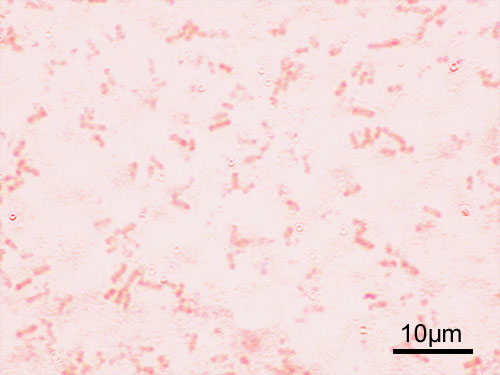
| Gram staining properties | Negative |
| Shape | Rod |
| Mobility | No |
| Flagellar presence | Yes |
| Number of membranes | 2 |

Image source: Wikipedia/Wikimedia
| Ecology, Host, and Life Cycle | |
|---|---|
| Oxygen requirements | Facultative anaerobe |
| Optimal temperature | 37 |
| Temperature range | Mesophilic |
| Habitat | HostAssociated |
| Biotic relationship | Free living |
| Host(s) | Not Available |
| Cell arrangement | Pairs - Singles |
| Sporulation | Not Available |
| Energy source | Chemoorganotroph |
| Pathogenicity | Not Available |
Gene Summary
Adenine Count
1128216 bp
Thymine Count
1123711 bp
Guanine Count
1187326 bp
Cytosine Count
1174304 bp
Genome Length
4613557 bp
Protein-coding Genes
5602 genes
Non-Coding Genes
396 genes
# of Chromosomes/Plasmids
2
Genes
| Name | Locus Tag | UniProt ID | Strand Orientation | Gene Start/End | Protein Molecular Weight |
|---|---|---|---|---|---|
| amino acid permease | ASD1617_RS09045 | Not Available | Negative | 1392788 - 1394170 | 49534.5 |
| duf1471 family protein ydgh | ASD1617_RS09050 | Not Available | Negative | 1394356 - 1395300 | 33874.9 |
| re/si-specific nad(p)(+) transhydrogenase subunit alpha | ASD1617_RS09055 | Not Available | Positive | 1395824 - 1397356 | 54587.5 |
| re/si-specific nad(p)(+) transhydrogenase subunit beta | ASD1617_RS09060 | Not Available | Positive | 1397367 - 1398755 | 48726.0 |
| ai-2 transporter tqsa | ASD1617_RS09065 | Not Available | Negative | 1398780 - 1399814 | 37531.3 |
| quaternary ammonium compound-resistance protein | ASD1617_RS09075 | Not Available | Positive | 1400226 - 1400414 | 6673.58 |
| multidrug/spermidine efflux smr transporter subunit mdti | ASD1617_RS09080 | Not Available | Positive | 1400401 - 1400730 | 11765.8 |
| trypsin-like serine peptidase | ASD1617_RS09085 | Not Available | Negative | 1400769 - 1401590 | 29234.6 |
| hypothetical protein | ASD1617_RS09090 | Not Available | Negative | 1401690 - 1401773 | 3206.2 |
| acid resistance repetitive basic protein asr | ASD1617_RS09095 | Not Available | Negative | 1401866 - 1402201 | 11538.0 |
Pathways
0 pathways
No pathways found
No metabolic pathways have been associated with this bacterium yet.
Health Effects
No health effects information available for this bacterium.