Kingdom
Pseudomonadati
Phylum
Pseudomonadota
Class
Gammaproteobacteria
Order
Enterobacterales
Family
Enterobacteriaceae
Genus
Shigella
Description
Taxonomy
| Kingdom | Pseudomonadati |
|---|---|
| Phylum | Pseudomonadota |
| Class | Gammaproteobacteria |
| Order | Enterobacterales |
| Family | Enterobacteriaceae |
| Genus | Shigella |
| Species | Shigella dysenteriae |
| Strain | 1617 |
Profile
| Physiology | |
|---|---|
| Gram staining properties | Negative |
| Shape | Rod |
| Mobility | No |
| Flagellar presence | Yes |
| Number of membranes | 2 |

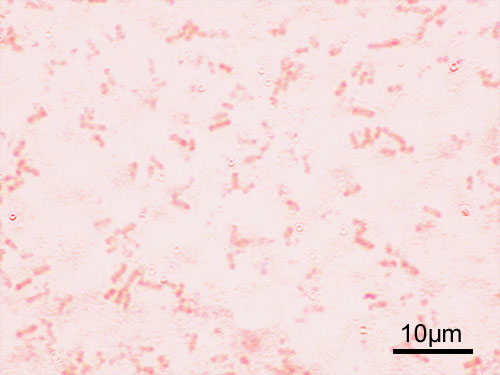
Image source: Wikipedia/Wikimedia
| Ecology, Host, and Life Cycle | |
|---|---|
| Oxygen requirements | Facultative anaerobe |
| Optimal temperature | 37 |
| Temperature range | Mesophilic |
| Habitat | HostAssociated |
| Biotic relationship | Free living |
| Host(s) | Not Available |
| Cell arrangement | Pairs - Singles |
| Sporulation | Not Available |
| Energy source | Chemoorganotroph |
| Pathogenicity | Not Available |
Gene Summary
Adenine Count
1128216 bp
Thymine Count
1123711 bp
Guanine Count
1187326 bp
Cytosine Count
1174304 bp
Genome Length
4613557 bp
Protein-coding Genes
5602 genes
Non-Coding Genes
396 genes
# of Chromosomes/Plasmids
2
Genes
| Name | Locus Tag | UniProt ID | Strand Orientation | Gene Start/End | Protein Molecular Weight |
|---|---|---|---|---|---|
| winged helix-turn-helix domain-containing protein | ASD1617_RS06635 | Not Available | Negative | 1063639 - 1064878 | 44458.6 |
| winged helix-turn-helix domain-containing protein | ASD1617_RS06640 | Not Available | Negative | 1064986 - 1065258 | 9893.94 |
| winged helix-turn-helix domain-containing protein | ASD1617_RS06645 | Not Available | Negative | 1065334 - 1066042 | 25480.8 |
| is1 family transposase | ASD1617_RS06655 | Not Available | Negative | 1066095 - 1066157 | 2191.65 |
| hypothetical protein | ASD1617_RS06660 | Not Available | Negative | 1066193 - 1066810 | 23926.3 |
| duf72 domain-containing protein | ASD1617_RS06665 | Not Available | Positive | 1066914 - 1067261 | 13162.9 |
| mapeg family protein | ASD1617_RS06670 | Not Available | Positive | 1067314 - 1067709 | 15227.2 |
| carboxy-s-adenosyl-l-methionine synthase cmoa | ASD1617_RS06675 | Not Available | Positive | 1067750 - 1068493 | 27792.3 |
| trna 5-methoxyuridine(34)/uridine 5-oxyacetic acid(34) synthase cmob | ASD1617_RS06680 | Not Available | Positive | 1068490 - 1069461 | 37028.6 |
| trimethylamine n-oxide reductase torz | ASD1617_RS06685 | Not Available | Negative | 1069626 - 1071968 | 85836.3 |
Pathways
0 pathways
No pathways found
No metabolic pathways have been associated with this bacterium yet.
Health Effects
No health effects information available for this bacterium.