Kingdom
Pseudomonadati
Phylum
Pseudomonadota
Class
Gammaproteobacteria
Order
Enterobacterales
Family
Enterobacteriaceae
Genus
Escherichia
Description
Taxonomy
| Kingdom | Pseudomonadati |
|---|---|
| Phylum | Pseudomonadota |
| Class | Gammaproteobacteria |
| Order | Enterobacterales |
| Family | Enterobacteriaceae |
| Genus | Escherichia |
| Species | Escherichia coli |
| Strain | Xuzhou21 |
Profile
| Physiology | |
|---|---|
| Gram staining properties | Negative |
| Shape | Rod |
| Mobility | Yes |
| Flagellar presence | Yes |
| Number of membranes | 2 |

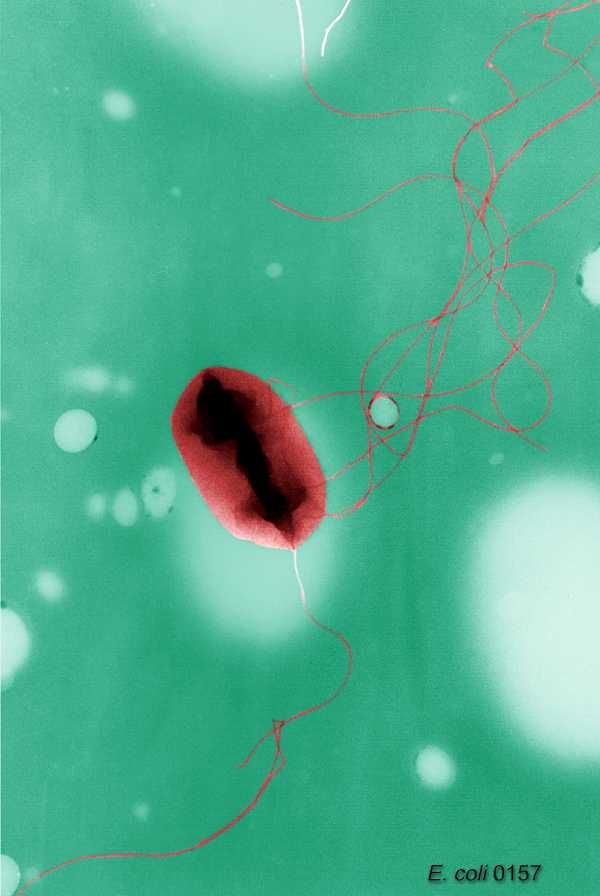
Image source: Wikipedia/Wikimedia
| Ecology, Host, and Life Cycle | |
|---|---|
| Oxygen requirements | Facultative anaerobe |
| Optimal temperature | 37 |
| Temperature range | Mesophilic |
| Habitat | HostAssociated |
| Biotic relationship | Free living |
| Host(s) | Not Available |
| Cell arrangement | Pairs - Singles |
| Sporulation | Not Available |
| Energy source | Not Available |
| Pathogenicity | Not Available |
Genome Summary
Escherichia coli Xuzhou21 plasmid pO157, complete sequence.
Gene Summary
Adenine Count
24869 bp
Thymine Count
23720 bp
Guanine Count
23873 bp
Cytosine Count
20266 bp
Genome Length
92728 bp
Protein-coding Genes
96 genes
Non-Coding Genes
0 genes
# of Chromosomes/Plasmids
3
Genes
| Name | Locus Tag | UniProt ID | Strand Orientation | Gene Start/End | Protein Molecular Weight |
|---|---|---|---|---|---|
| hth-type transcriptional regulator metr | CDCO157_RS24410 | P0A9G0 | Negative | 4734925 - 4735878 | 35631.0 |
| 5-methyltetrahydropteroyltriglutamate-- homocysteine s-methyltransferase | CDCO157_RS24415 | Q8X8L5 | Positive | 4736114 - 4738375 | 84727.2 |
| dienelactone hydrolase family protein | CDCO157_RS24420 | Q8X8L4 | Negative | 4738415 - 4739230 | 29397.8 |
| uridine phosphorylase | CDCO157_RS24425 | P12758 | Positive | 4739492 - 4740253 | 27151.7 |
| dna recombination protein rmuc | CDCO157_RS24430 | P0AG72 | Positive | 4740394 - 4741821 | 54767.6 |
| bifunctional demethylmenaquinone methyltransferase/2-methoxy-6-polyprenyl-1,4-benzoquinol methylase ubie | CDCO157_RS24435 | A7ZU40 | Positive | 4741916 - 4742671 | 28074.8 |
| ubiquinone biosynthesis protein ubij | CDCO157_RS24440 | P0ADP7 | Positive | 4742685 - 4743290 | 22077.8 |
| ubiquinone biosynthesis regulatory protein kinase ubib | CDCO157_RS24445 | A7ZU42 | Positive | 4743287 - 4744927 | 63206.4 |
| sec-independent protein translocase subunit tata | CDCO157_RS24450 | P69430 | Positive | 4745006 - 4745275 | 9664.5 |
| sec-independent protein translocase protein tatb | CDCO157_RS24455 | P69426 | Positive | 4745279 - 4745794 | 18421.8 |
Pathways
12367 pathways
Health Effects
No health effects information available for this bacterium.