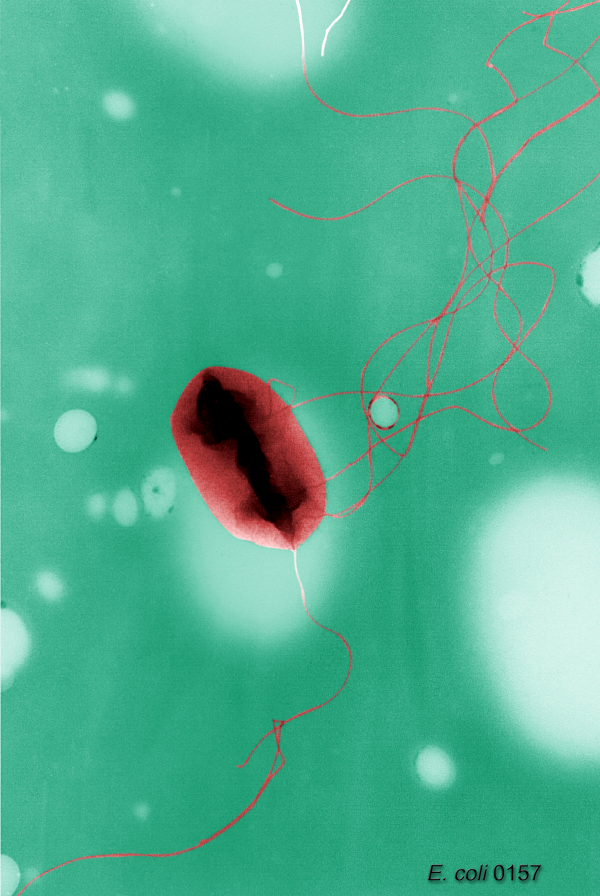
Escherichia coli UMNK88

Gram-negativeRodMotileFacultative anaerobe

Kingdom

Pseudomonadati

Phylum

Pseudomonadota

Class

Gammaproteobacteria

Order

Enterobacterales

Family

Enterobacteriaceae

Genus

Escherichia

Description

Escherichia coli UMNK88 is a microorganism that belongs to the E. coli species, a prominent and well-studied bacterium. According to the Microbe Directory, this strain has a temperature preference category of "mesophilic", meaning it thrives in moderate temperatures ranging from 20 to 40°C. E. coli UMNK88 is a chemo-heterotroph, able to metabolize organic compounds as its energy source, as it is a facultative anaerobe, meaning it can grow both in the presence and absence of oxygen. Its energy production is primarily achieved through the breakdown of glucose and other organic molecules. E. coli UMNK88 is a Gram-negative bacterium, with an outer membrane consisting of lipopolysaccharides, which provides an additional layer of protection against antibiotics and other substances. Its shape is typical of E. coli, being a rod-shaped bacterium, with a specific length and width. It is found in the human gastrointestinal tract, as well as other body sites such as the urinary tract, respiratory tract, and skin. In terms of oxygen preference, E. coli UMNK88 is a facultative anaerobe, able to grow in both aerobic and anaerobic conditions. This microbe is one of the most well-studied bacteria in the world, with a wealth of knowledge on its genetic makeup, physiology, and behavior. E. coli UMNK88 is a key model organism for understanding the physiology and biochemistry of bacteria, and has been used extensively in scientific research, particularly in the fields of molecular biology and biotechnology.

Taxonomy

KingdomPseudomonadati
PhylumPseudomonadota
ClassGammaproteobacteria
OrderEnterobacterales
FamilyEnterobacteriaceae
GenusEscherichia
SpeciesEscherichia coli
StrainUMNK88

Profile

Physiology
Gram staining propertiesNegative
ShapeRod
MobilityYes
Flagellar presenceYes
Number of membranes2
Image of Escherichia coli UMNK88
Image source: Wikipedia/Wikimedia
Ecology, Host, and Life Cycle
Oxygen requirementsFacultative anaerobe
Optimal temperature37
Temperature rangeMesophilic
HabitatHostAssociated
Biotic relationshipFree living
Host(s)Not Available
Cell arrangementPairs - Singles
SporulationNot Available
Energy sourceNot Available
PathogenicityNot Available

Genome Summary

Escherichia coli UMNK88 plasmid pUMNK88_91, complete sequence.

Gene Summary

Adenine Count

21816 bp

Thymine Count

23312 bp

Guanine Count

23528 bp

Cytosine Count

22212 bp

Genome Length

90868 bp

Protein-coding Genes

101 genes

Non-Coding Genes

0 genes

# of Chromosomes/Plasmids

6

Genes

NameLocus TagUniProt IDStrand OrientationGene Start/EndProtein Molecular Weight
hypothetical proteinUMNK88_RS28525Not AvailableNegative17510 - 1784511994.1
duf1643 domain-containing proteinUMNK88_RS28530Not AvailablePositive17942 - 1843017821.6
hypothetical proteinUMNK88_RS28535Not AvailablePositive18433 - 1893018424.3
is6-like element is26 family transposaseUMNK88_RS28540Not AvailableNegative19145 - 1984927870.8
hypothetical proteinUMNK88_RS28545Not AvailableNegative19914 - 200936463.79
is6-like element is26 family transposaseUMNK88_RS28550Not AvailablePositive20400 - 2110427896.9
hypothetical proteinUMNK88_RS34160Not AvailablePositive21110 - 212505426.51
recombinase family proteinUMNK88_RS28555Not AvailablePositive21735 - 2247226978.4
hypothetical proteinUMNK88_RS28560Not AvailablePositive22469 - 226938498.13
is91-like element isvsa3 family transposaseUMNK88_RS28565Not AvailablePositive22904 - 2439755631.3

Displaying genes 131 – 140 of 5817 in total

Metabolites

4785 records
Metabolite IDMetabolite nameStructureCAS number
BASm0000173(R)-3-Hydroxybutyric acidC4H8O3Chemical structure of (R)-3-Hydroxybutyric acid625-72-3
Average104.0473Da
Monoisotopic104.047344122Da
BASm0000217alpha-ribazoleC14H18N2O4Chemical structure of alpha-ribazoleNot available
Average278.3037Da
Monoisotopic278.126657074Da
BASm0000237(R)-4'-phosphopantothenateC9H18NO8PChemical structure of (R)-4'-phosphopantothenateNot available
Average299.2149Da
Monoisotopic299.0770031Da
BASm0000238(R)-3-phenyllactateC9H9O3Chemical structure of (R)-3-phenyllactateNot available
Average165.169Da
Monoisotopic165.05571773Da
BASm00002482,3-dihydroxy-3-methylbutanoateC5H10O4Chemical structure of 2,3-dihydroxy-3-methylbutanoate1756-18-9
Average134.1305Da
Monoisotopic134.0579088Da
BASm00002502,5-didehydro-D-gluconateC6H7O7Chemical structure of 2,5-didehydro-D-gluconate53736-12-2
Average191.1156Da
Monoisotopic191.019177578Da
BASm00002512-dehydropantoateC6H9O4Chemical structure of 2-dehydropantoateNot available
Average145.1333Da
Monoisotopic145.050083776Da
BASm00002532-oxopent-4-enoateC5H5O3Chemical structure of 2-oxopent-4-enoateNot available
Average113.093Da
Monoisotopic113.024417601Da
BASm00002593alpha,12alpha-dihydroxy-7-oxo-5beta-cholanateC24H37O5Chemical structure of 3alpha,12alpha-dihydroxy-7-oxo-5beta-cholanateNot available
Average405.556Da
Monoisotopic405.264647871Da
BASm00002603alpha,7alpha-dihydroxy-12-oxo-5beta-cholanateC24H37O5Chemical structure of 3alpha,7alpha-dihydroxy-12-oxo-5beta-cholanateNot available
Average405.556Da
Monoisotopic405.264647871Da

Displaying 1–10 of 4785 metabolites

Health Effects

No health effects information available for this bacterium.