Kingdom
Pseudomonadati
Phylum
Pseudomonadota
Class
Gammaproteobacteria
Order
Enterobacterales
Family
Enterobacteriaceae
Genus
Escherichia
Description
Taxonomy
| Kingdom | Pseudomonadati |
|---|---|
| Phylum | Pseudomonadota |
| Class | Gammaproteobacteria |
| Order | Enterobacterales |
| Family | Enterobacteriaceae |
| Genus | Escherichia |
| Species | Escherichia coli |
| Strain | H386 |
Profile
| Physiology | |
|---|---|
| Gram staining properties | Negative |
| Shape | Rod |
| Mobility | Yes |
| Flagellar presence | Yes |
| Number of membranes | 2 |

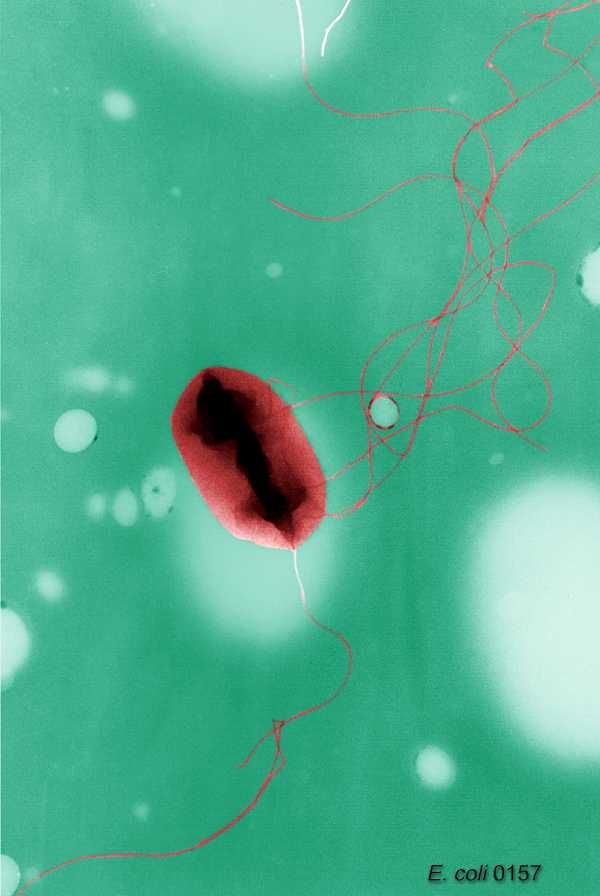
Image source: Wikipedia/Wikimedia
| Ecology, Host, and Life Cycle | |
|---|---|
| Oxygen requirements | Facultative anaerobe |
| Optimal temperature | 37 |
| Temperature range | Mesophilic |
| Habitat | HostAssociated |
| Biotic relationship | Free living |
| Host(s) | Not Available |
| Cell arrangement | Pairs - Singles |
| Sporulation | Not Available |
| Energy source | Not Available |
| Pathogenicity | Not Available |
Gene Summary
Adenine Count
1308057 bp
Thymine Count
1308816 bp
Guanine Count
1335192 bp
Cytosine Count
1336812 bp
Genome Length
5342020 bp
Protein-coding Genes
5175 genes
Non-Coding Genes
337 genes
# of Chromosomes/Plasmids
1
Genes
| Name | Locus Tag | UniProt ID | Strand Orientation | Gene Start/End | Protein Molecular Weight |
|---|---|---|---|---|---|
| inner membrane abc transporter permease protein ycjo | ECVG_03685 | Not Available | Positive | 1639349 - 1640230 | 33227.3 |
| inner membrane abc transporter permease protein ycjp | ECVG_03686 | Not Available | Positive | 1640217 - 1641059 | 31252.2 |
| putative oxidoreductase | ECVG_03687 | Not Available | Positive | 1641090 - 1642142 | 38208.6 |
| putative transient receptor potential locus | ECVG_03688 | Not Available | Positive | 1642152 - 1642949 | 30221.1 |
| putative oxidoreductase ycjs | ECVG_03689 | Not Available | Positive | 1642959 - 1644014 | 38718.4 |
| putative transport protein ycjt | ECVG_03690 | Not Available | Positive | 1644011 - 1646278 | 84862.0 |
| beta-phosphoglucomutase | ECVG_03691 | Not Available | Positive | 1646275 - 1646934 | 23566.3 |
| putative atp-binding component of a transport system | ECVG_03692 | Not Available | Positive | 1646948 - 1648030 | 40149.0 |
| outer membrane protein g | ECVG_03693 | Not Available | Positive | 1648075 - 1648980 | 34915.0 |
| putative laci-type transcriptional regulator | ECVG_03694 | Not Available | Negative | 1649091 - 1650089 | 36136.2 |
Pathways
12367 pathways
Health Effects
No health effects information available for this bacterium.