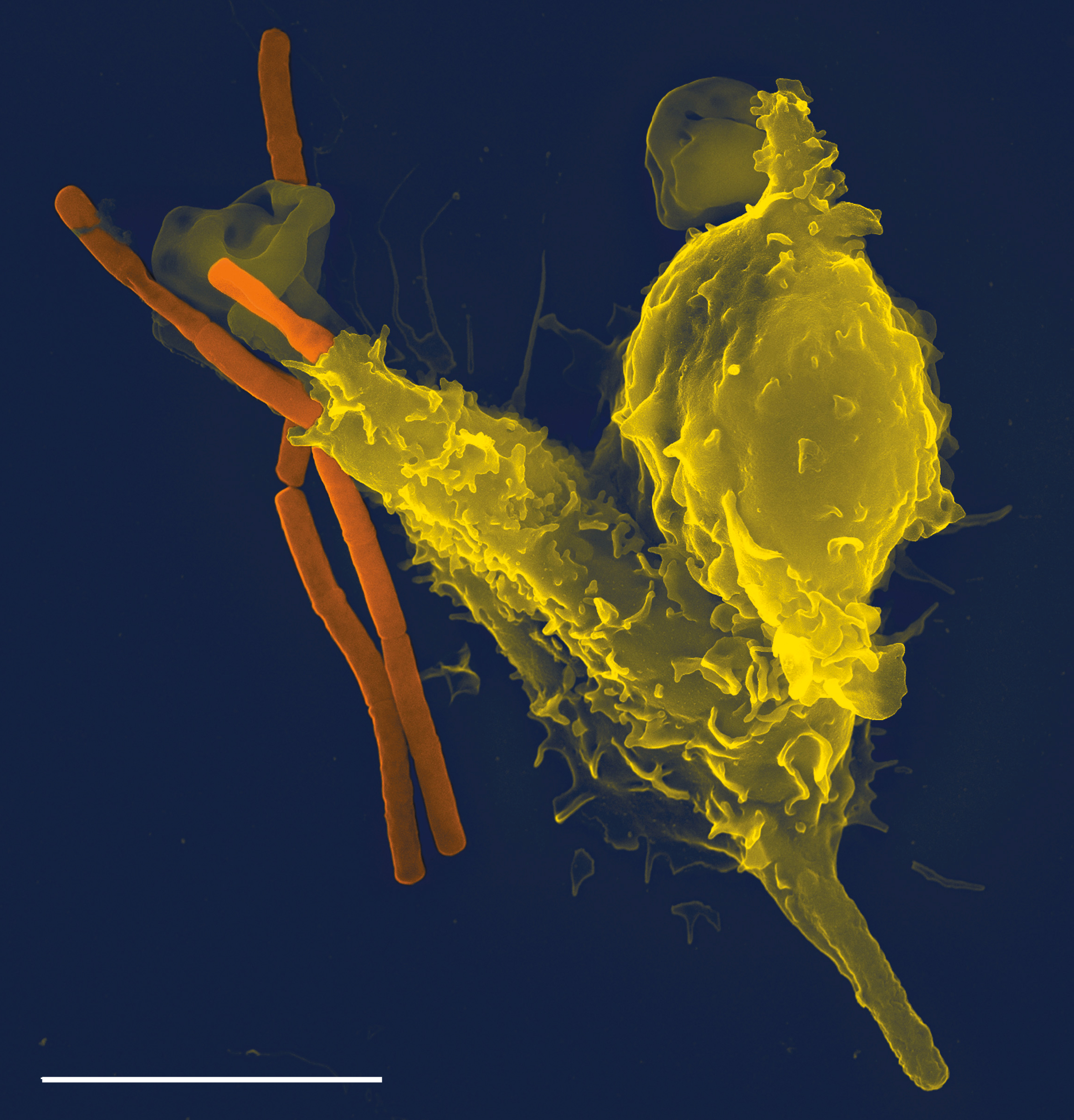
Kingdom
Bacillati
Phylum
Bacillota
Class
Bacilli
Order
Caryophanales
Family
Bacillaceae
Genus
Bacillus
Description
Taxonomy
| Kingdom | Bacillati |
|---|---|
| Phylum | Bacillota |
| Class | Bacilli |
| Order | Caryophanales |
| Family | Bacillaceae |
| Genus | Bacillus |
| Species | Bacillus anthracis |
| Strain | CI |
Profile
| Physiology | |
|---|---|
| Gram staining properties | Positive |
| Shape | Rod |
| Mobility | Yes |
| Flagellar presence | Yes |
| Number of membranes | 1 |

Image source: Wikipedia/Wikimedia
| Ecology, Host, and Life Cycle | |
|---|---|
| Oxygen requirements | Facultative |
| Optimal temperature | 37 |
| Temperature range | Mesophilic |
| Habitat | HostAssociated |
| Biotic relationship | Free living |
| Host(s) | Not Available |
| Cell arrangement | Not Available |
| Sporulation | Sporulating |
| Energy source | Chemoheterotroph |
| Pathogenicity | Yes |
Genome Summary
Bacillus cereus biovar anthracis str. CI plasmid pCI-XO2, complete
Gene Summary
Adenine Count
29648 bp
Thymine Count
33561 bp
Guanine Count
13451 bp
Cytosine Count
17809 bp
Genome Length
94469 bp
Protein-coding Genes
99 genes
Non-Coding Genes
0 genes
# of Chromosomes/Plasmids
4
Genes
| Name | Locus Tag | UniProt ID | Strand Orientation | Gene Start/End | Protein Molecular Weight |
|---|---|---|---|---|---|
| oxidoreductase | BACI_RS17630 | O32223 | Negative | 3352917 - 3353948 | 38795.6 |
| dna topoisomerase iv subunit a | BACI_RS17635 | Q45066 | Negative | 3354118 - 3356541 | 91512.8 |
| dna topoisomerase iv subunit b | BACI_RS17640 | Q59192 | Negative | 3356543 - 3358507 | 72970.9 |
| coa-binding protein | BACI_RS17650 | Q45065 | Negative | 3358884 - 3359297 | 15596.9 |
| s1c family serine protease | BACI_RS17655 | Not Available | Negative | 3359377 - 3360618 | 43871.1 |
| response regulator transcription factor | BACI_RS17660 | Not Available | Negative | 3360821 - 3361498 | 25768.2 |
| anaerobic ribonucleoside-triphosphate reductase activating protein | BACI_RS17665 | Q9KM76 | Negative | 3361518 - 3361970 | 16913.4 |
| anaerobic ribonucleoside triphosphate reductase | BACI_RS17670 | Q9L646 | Negative | 3361967 - 3363823 | 69637.9 |
| glycerol-3-phosphate 1-o-acyltransferase plsy | BACI_RS17675 | Q812Z6 | Positive | 3364049 - 3364645 | 21179.7 |
| hesb/yadr/yfhf family protein | BACI_RS17680 | Q45063 | Positive | 3364754 - 3365044 | 11115.7 |
Pathways
0 pathways
No pathways found
No metabolic pathways have been associated with this bacterium yet.
Health Effects
No health effects information available for this bacterium.