Kingdom
Pseudomonadati
Phylum
Pseudomonadota
Class
Gammaproteobacteria
Order
Enterobacterales
Family
Enterobacteriaceae
Genus
Salmonella
Description
Taxonomy
| Kingdom | Pseudomonadati |
|---|---|
| Phylum | Pseudomonadota |
| Class | Gammaproteobacteria |
| Order | Enterobacterales |
| Family | Enterobacteriaceae |
| Genus | Salmonella |
| Species | Salmonella enterica |
| Strain | subsp. enterica serovar Corvallis |
Profile
| Physiology | |
|---|---|
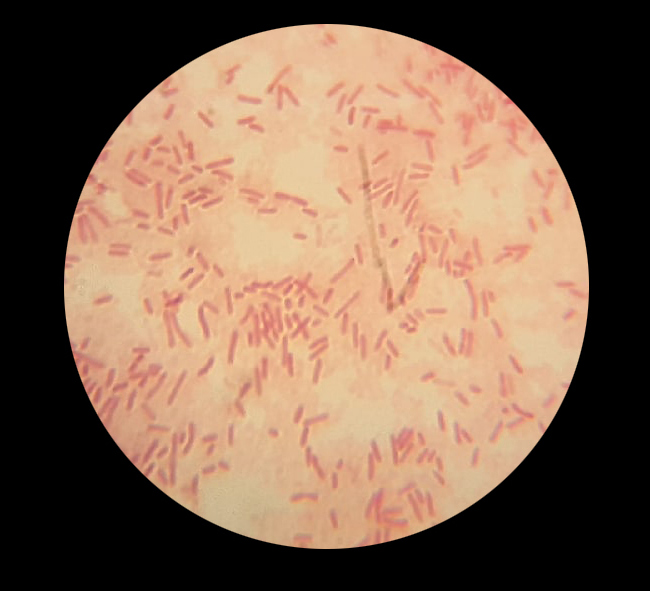
| Gram staining properties | Negative |
| Shape | Spirilla |
| Mobility | No |
| Flagellar presence | Yes |
| Number of membranes | 2 |

Image source: Wikipedia/Wikimedia
| Ecology, Host, and Life Cycle | |
|---|---|
| Oxygen requirements | Microaerophilic |
| Optimal temperature | 37 |
| Temperature range | Mesophilic |
| Habitat | HostAssociated |
| Biotic relationship | Free living |
| Host(s) | Homo sapiens, Aves |
| Cell arrangement | Chains - Singles |
| Sporulation | Not Available |
| Energy source | Chemoorganotroph |
| Pathogenicity | Not Available |
Genome Summary
Salmonella enterica subsp. enterica serovar Corvallis strain
Gene Summary
Adenine Count
1193288 bp
Thymine Count
1201633 bp
Guanine Count
1311261 bp
Cytosine Count
1284332 bp
Genome Length
4990514 bp
Protein-coding Genes
4587 genes
Non-Coding Genes
358 genes
# of Chromosomes/Plasmids
3
Genes
| Name | Locus Tag | UniProt ID | Strand Orientation | Gene Start/End | Protein Molecular Weight |
|---|---|---|---|---|---|
| metal-dependent hydrolase | E2E50_13140 | Not Available | Negative | 2644262 - 2644807 | 20215.2 |
| ribosome-associated protein ybcj | E2E50_13145 | Not Available | Negative | 2644935 - 2645147 | 7395.95 |
| bifunctional methylenetetrahydrofolate dehydrogenase/methenyltetrahydrofolate cyclohydrolase fold | E2E50_13150 | Not Available | Negative | 2645149 - 2646015 | 30845.4 |
| hypothetical protein | E2E50_13155 | Not Available | Positive | 2646378 - 2646572 | 7307.61 |
| type 1 fimbrial protein subunit fima | E2E50_13160 | Not Available | Positive | 2646562 - 2647119 | 18871.2 |
| type 1 fimbrial protein subunit fimi | E2E50_13165 | Not Available | Positive | 2647194 - 2647727 | 19128.3 |
| molecular chaperone fimc | E2E50_13170 | Not Available | Positive | 2647771 - 2648463 | 24843.2 |
| fimbrial biogenesis outer membrane usher protein | E2E50_13175 | Not Available | Positive | 2648494 - 2651106 | 95160.7 |
| type 1 fimbrin d-mannose specific adhesin fimh | E2E50_13180 | Not Available | Positive | 2651121 - 2652128 | 36102.9 |
| fimbriae assembly protein | E2E50_13185 | Not Available | Positive | 2652138 - 2652656 | 18027.5 |
Pathways
0 pathways
No pathways found
No metabolic pathways have been associated with this bacterium yet.